<?xml version="1.0" encoding="iso-8859-1"?>
<feed version="0.3" xmlns="http://purl.org/atom/ns#" xmlns:dc="http://purl.org/dc/elements/1.1/" xml:lang="en">
<title>No Media Kings</title>
<link rel="alternate" type="text/html" href="http://nomediakings.org/" />
<modified>2006-04-29T19:28:59Z</modified>
<tagline></tagline>
<id>tag:nomediakings.org,2006://2</id>
<generator url="http://www.movabletype.org/" version="3.2">Movable Type</generator>
<copyright>Copyright (c) 2006, Jim Munroe</copyright>
<entry>
<title>A Pick-Your-Own-Podventure</title>
<link rel="alternate" type="text/html" href="http://nomediakings.org/podcast/a_pickyourownpodventure.html" />
<modified>2006-04-29T19:28:59Z</modified>
<issued>2006-04-18T21:52:16Z</issued>
<id>tag:nomediakings.org,2006://2.800</id>
<created>2006-04-18T21:52:16Z</created>
<summary type="text/plain"> I got hooked on radio drama when I was young mostly by accident -- it followed the comedy hour on CHUM-FM. I listened to Orson Welles on the The Third Man serial long before I saw any of his movies. Thanks to various sites, I&apos;ve been enjoying the old time radio drama on my MP3 player. Almost a year ago I was struck with the idea that it would be interesting to make a kind of audio drama that took advantage of the MP3 player, to turn it into a kind of primitive interactive story. I grew up on computer text games like Zork and books of the Choose-Your-Own-Adventure ilk so it was a natural fit. And here’s the result: the first 20 minute episode of “The Letter” that you can listen to on an MP3 player or the computer. At the end of each track, you decide what should happen next......</summary>
<author>
<name>Jim Munroe</name>
<url>http://nomediakings.org</url>
<email>jim@nomediakings.org</email>
</author>
<dc:subject>Podcast</dc:subject>
<content type="text/html" mode="escaped" xml:lang="en" xml:base="http://nomediakings.org/">
<![CDATA[<img alt="Kevin at the session." src="http://nomediakings.org/podcast/podventure-thumb.jpg" width="100" height="100" hspace=5 vspace=5 align=left>
I got hooked on radio drama when I was young mostly by accident -- it followed the comedy hour on CHUM-FM. I listened to Orson Welles on the The Third Man serial long before I saw any of his movies. Thanks to <a href="http://www.radiolovers.com/">various</a> <a href="http://www.mercurytheatre.info/">sites</a>, I've been enjoying the old time radio drama on my MP3 player.
<P>
Almost a year ago I was struck with the idea that it would be interesting to make a kind of audio drama that took advantage of the MP3 player, to turn it into a kind of primitive interactive story. I grew up on computer text games like Zork and books of the Choose-Your-Own-Adventure ilk so it was a natural fit. And here’s the result: the first 20 minute episode of “The Letter” that you can listen to on an MP3 player or the computer. At the end of each track, you decide what should happen next...<p>]]>
<![CDATA[<br><img alt="The recording session." src="http://nomediakings.org/podcast/podventure-web.jpg" width="250" height="239" hspace=5 vspace=5 align=right>
<strong>How To Listen/Play</strong><p>
<u>On any MP3 player:</u><br>
<a href="http://www.archive.org/download/The.Letter.Episode.One/The.Letter.Episode.One_64kb_mp3.zip">Right-click and save</a> this zipped file, unzip it, and drop it into your player. [13 MP3 files, 11megs]<p>
<u>On an iPod:</u><br>
If you put <a href="http://nomediakings.org/podcast/index.xml">this podcast feed</a> in your iTunes or <a href="http://phobos.apple.com/WebObjects/MZStore.woa/wa/viewPodcast?id=150315778&amp;s=143455">click here</a> to launch iTunes it will automatically download this and future episodes in <a href="http://www.archive.org/download/The.Letter.Episode.One/The.Letter.Episode.One.m4b">enhanced chapterized AAC format</a>. [single m4b file, 12megs] Note: if you're going to listen to it in iTunes, you're better off with the option below.<P> 
<p>
<u>On the computer via a music player or iTunes:</u> <br>
There's a  <a href="http://www.archive.org/download/The.Letter.Episode.One/The.Letter.Episode.One_64kb.m3u">low-fi</a> or <a href="http://www.archive.org/download/The.Letter.Episode.One/The.Letter.Episode.One_128kb.m3u">hi-fi</a> playlists of the episode, click one and see if it launches an external music player.
<p>
If that doesn't work you could try this Flash player below:
<object type="application/x-shockwave-flash" width="300" height="17"
data="http://nomediakings.org/xspf_player_slim.swf?playlist_url=http://nomediakings.org/podventure.xspf&player_title=The Letter Episode 1">
<param name="movie" 
value="http://nomediakings.org/xspf_player_slim.swf?playlist_url=http://nomediakings.org/podventure.xspf&player_title=The Letter Episode 1" />
</object><p>
There's also a bunch of different formats and sizes on this <a href="http://www.archive.org/details/The.Letter.Episode.One">archive.org</a> page.
<p>
If you have trouble, please let me know via the comments below!
<P><strong>More Episodes</strong><P>Thanks to an enthusiastic group of voice actors and other helpful folk, this has been a really fun project, requiring me to collect sounds in alleys and take notes on panel vans. If you're interested in hearing a second episode, consider making a Paypal donation below. I don't mind working for free, but it'd be nice to be able to throw a party for the cast. Also, <a href="mailto:jim@nomediakings.org">feedback</a> is always welcome, I like criticism. If you'd like to hear about new episodes via email you can subscribe on the left sidebar.<P><form action="https://www.paypal.com/cgi-bin/webscr" method="post">
<input type="hidden" name="cmd" value="_s-xclick">
<input type="image" src="https://www.paypal.com/en_US/i/btn/x-click-but21.gif" border="0" name="submit" alt="Make payments with PayPal - it's fast, free and secure!">
<img alt="" border="0" src="https://www.paypal.com/en_US/i/scr/pixel.gif" width="1" height="1">
<input type="hidden" name="encrypted" value="-----BEGIN PKCS7-----MIIHRwYJKoZIhvcNAQcEoIIHODCCBzQCAQExggEwMIIBLAIBADCBlDCBjjELMAkGA1UEBhMCVVMxCzAJBgNVBAgTAkNBMRYwFAYDVQQHEw1Nb3VudGFpbiBWaWV3MRQwEgYDVQQKEwtQYXlQYWwgSW5jLjETMBEGA1UECxQKbGl2ZV9jZXJ0czERMA8GA1UEAxQIbGl2ZV9hcGkxHDAaBgkqhkiG9w0BCQEWDXJlQHBheXBhbC5jb20CAQAwDQYJKoZIhvcNAQEBBQAEgYBEQXRa/OCSJhPaIhZVBvpW8Fn0S6TiyKr5vFHNVD7Dt+3wtZ60zC5onHSQe2jy28Hy6ybZV6aQ4MIdEz/g+zdIQfOOHSiT5VabSIIMtaBFyC+J1lX4vPgdkCyCkYDvP11oCC2hZmhr2400RvEy9cXzXTc6WjJdDEGj4DLWhhveETELMAkGBSsOAwIaBQAwgcQGCSqGSIb3DQEHATAUBggqhkiG9w0DBwQIR6aeSE6YIS2AgaAY1QwAZ9TWzil8d0vLG94oMWJsu7KpStC1kw9Y+M4jW7cLK4i9r086ZrA3cQig6twpG0Fr6kLBj0eZR0fW55SQVpduQLu2ntefQ0QOmj8r/239BKPnJ5m+fiX5Ja2j0FW/yDJzKnv+4//AKzAZ5QH7Hnh4A+q4ReWhbYSfcNK+pTFnnhwWewb1J7mdy2fWS5hqzbzH+kUAgknpKUFO/UzioIIDhzCCA4MwggLsoAMCAQICAQAwDQYJKoZIhvcNAQEFBQAwgY4xCzAJBgNVBAYTAlVTMQswCQYDVQQIEwJDQTEWMBQGA1UEBxMNTW91bnRhaW4gVmlldzEUMBIGA1UEChMLUGF5UGFsIEluYy4xEzARBgNVBAsUCmxpdmVfY2VydHMxETAPBgNVBAMUCGxpdmVfYXBpMRwwGgYJKoZIhvcNAQkBFg1yZUBwYXlwYWwuY29tMB4XDTA0MDIxMzEwMTMxNVoXDTM1MDIxMzEwMTMxNVowgY4xCzAJBgNVBAYTAlVTMQswCQYDVQQIEwJDQTEWMBQGA1UEBxMNTW91bnRhaW4gVmlldzEUMBIGA1UEChMLUGF5UGFsIEluYy4xEzARBgNVBAsUCmxpdmVfY2VydHMxETAPBgNVBAMUCGxpdmVfYXBpMRwwGgYJKoZIhvcNAQkBFg1yZUBwYXlwYWwuY29tMIGfMA0GCSqGSIb3DQEBAQUAA4GNADCBiQKBgQDBR07d/ETMS1ycjtkpkvjXZe9k+6CieLuLsPumsJ7QC1odNz3sJiCbs2wC0nLE0uLGaEtXynIgRqIddYCHx88pb5HTXv4SZeuv0Rqq4+axW9PLAAATU8w04qqjaSXgbGLP3NmohqM6bV9kZZwZLR/klDaQGo1u9uDb9lr4Yn+rBQIDAQABo4HuMIHrMB0GA1UdDgQWBBSWn3y7xm8XvVk/UtcKG+wQ1mSUazCBuwYDVR0jBIGzMIGwgBSWn3y7xm8XvVk/UtcKG+wQ1mSUa6GBlKSBkTCBjjELMAkGA1UEBhMCVVMxCzAJBgNVBAgTAkNBMRYwFAYDVQQHEw1Nb3VudGFpbiBWaWV3MRQwEgYDVQQKEwtQYXlQYWwgSW5jLjETMBEGA1UECxQKbGl2ZV9jZXJ0czERMA8GA1UEAxQIbGl2ZV9hcGkxHDAaBgkqhkiG9w0BCQEWDXJlQHBheXBhbC5jb22CAQAwDAYDVR0TBAUwAwEB/zANBgkqhkiG9w0BAQUFAAOBgQCBXzpWmoBa5e9fo6ujionW1hUhPkOBakTr3YCDjbYfvJEiv/2P+IobhOGJr85+XHhN0v4gUkEDI8r2/rNk1m0GA8HKddvTjyGw/XqXa+LSTlDYkqI8OwR8GEYj4efEtcRpRYBxV8KxAW93YDWzFGvruKnnLbDAF6VR5w/cCMn5hzGCAZowggGWAgEBMIGUMIGOMQswCQYDVQQGEwJVUzELMAkGA1UECBMCQ0ExFjAUBgNVBAcTDU1vdW50YWluIFZpZXcxFDASBgNVBAoTC1BheVBhbCBJbmMuMRMwEQYDVQQLFApsaXZlX2NlcnRzMREwDwYDVQQDFAhsaXZlX2FwaTEcMBoGCSqGSIb3DQEJARYNcmVAcGF5cGFsLmNvbQIBADAJBgUrDgMCGgUAoF0wGAYJKoZIhvcNAQkDMQsGCSqGSIb3DQEHATAcBgkqhkiG9w0BCQUxDxcNMDYwNDE4MjIzNjU0WjAjBgkqhkiG9w0BCQQxFgQU5OTJ4o7aIMpzu2k1MudGPp/gP74wDQYJKoZIhvcNAQEBBQAEgYAo1eIOWo8amevkQa8ADdaWa5F93FE7edQYmguycDSjlEeKXAunfjPdx/C4l9+CF6tmmLvdzHkX1gRSINzCXrJzhJEONmd4cPfiaxnBdQHIH3dSwn1+yU66otbhI1tAAxJGuLouAKuOsNDszQ43ztOpt1GUpECOxi77lRiKowULFg==-----END PKCS7-----
">
</form>

Feel free to distribute, it's got a Creative Commons <a href="http://creativecommons.org/licenses/by-nc-sa/2.5/">Attribution-NonCommercial-ShareAlike</a> licence. I'd be happy to see other people make pick-your-own-podventures of their own. God knows I'm not the first to make something old new again -- <a href="http://decoderringtheatre.com/">Decoder Ring Theatre</a> and Joey Dubuc's <a href="http://home.ican.net/~conpress/backcat.html">Neither Either Nor Or</a> are two inspiring examples.<p>
<b>Credits</b><p>
"The Letter" <br>
Episode 1<br>
a pick-your-own-podventure<br>
written and produced by Jim Munroe<br>
sound engineered by <a href="http://stopdie.com">Lyle Crilly</a><br>
and starring Kevin Fell and <a href="http://stopdie.com">Luke Costello</a><br>
<p>
with (in approximate order of appearance) <a href="http://ladyscientist.com">Susan Bustos</a> as the Choice Voice, Jim Munroe as Man-In-Black 1, <a href="http://seandhi.com">Sean Lerner</a> as Man-In-Black 2, Michael Higginson as Mike, Jessica Westhead as Stef, Guy Leshinski as Dr. Kinderson, <a href="http://www.photoderek.com">Derek Wuenschirs</a> as Other Voice, and Lyle Crilly as Alex.
<p>
Special thanks to Paul Lamoth and <a href="http://myspace.com/_matias_">Matias Rozenberg</a> for the use of their microphones, <a href="http://autovaud.com">Mark Slutsky</a> for the AAC action, and Susan Bustos, Guy Leshinski, Carma Jolly, Jon Sasaki, Sean Lerner and <a href="http://decoderring.libsyn.com/">Gregg Taylor</a> for excellent script feedback.<br>]]>
</content>
</entry>
<entry>
<title>Take Our Taste Test</title>
<link rel="alternate" type="text/html" href="http://nomediakings.org/vidz/take_our_taste_test.html" />
<modified>2006-04-11T17:04:53Z</modified>
<issued>2006-04-11T16:41:56Z</issued>
<id>tag:nomediakings.org,2006://2.789</id>
<created>2006-04-11T16:41:56Z</created>
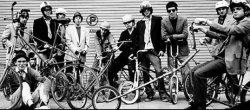
<summary type="text/plain">My pal Scott lent me his copy of The Winking Circle, a DVD made by some kids in small-town Ontario that documents their attempts to &quot;eccentrify their lives.&quot; More than anything else I&apos;ve seen, it reflects the essence of the cut-n-paste photocopied zines -- it&apos;s an hour long piece that masterfully mixes the visual eye-candy of skateboard stunts and crazy haircuts and artbikes with stirring music and non-idealogical philosophy. It&apos;s spectacle reclaimed, really: spectacle given a soul. So it&apos;s not so strange, really, that Coke wanted a piece of it. And why go to the trouble of buying something you can just steal?...</summary>
<author>
<name>Jim Munroe</name>
<url>http://nomediakings.org</url>
<email>jim@nomediakings.org</email>
</author>
<dc:subject>Vidz</dc:subject>
<content type="text/html" mode="escaped" xml:lang="en" xml:base="http://nomediakings.org/">
<![CDATA[<p><img alt="winking-thumb.jpg" src="http://nomediakings.org/vidz/winking-thumb.jpg" width="100" height="100" hspace=5 vspace=5 align=left>My pal <a href="http://scottwaters.ca">Scott</a> lent me his copy of The Winking Circle, a DVD made by some kids in small-town Ontario that documents their attempts to "eccentrify their lives." More than anything else I've seen, it reflects the essence of the cut-n-paste photocopied zines -- it's an hour long piece that masterfully mixes the visual eye-candy of skateboard stunts and crazy haircuts and artbikes with stirring music and non-idealogical philosophy. It's spectacle reclaimed, really: spectacle given a soul.</p>

<p>So it's not so strange, really, that Coke wanted a piece of it. And why go to the trouble of buying something you can just steal?</p>]]>
<![CDATA[<p>When Benny started telling me that there was a commercial that looked suspiciously like his Winking Circle DVD, I didn't really think there was anything underhanded going on. You hear a lot of conspiracy theories, and usually they can be chalked up to the fact that, despite our differences, the corporate and indie creators are all fishing in the same zeitgeist and sometimes our hooks get intertwined. Even Benny, despite shocked phone calls from friends who'd seen it, didn't think there was a direct connection. What are the chances that one of the world's largest corporations would stoop to petty theft? </p>

<p><img alt="winking-web.jpg" src="http://nomediakings.org/vidz/winking-web.jpg" width="250" height="110" hspace=5 vspace=5 align=right>But out of curiosity he googled the ad firm who'd made the commercial and oddly enough it was a Toronto company who did it. So he brought the situation to the attention of a hotshot law firm, and they agreed to take on the case: and it was strong enough that they took it on for free.</p>

<p>Generally, I consider the relationship between the counter-culture and the dominant culture to be <a href="http://nomediakings.org/writing/sellout.html">a complex one</a>. But when I saw that ad, I was shocked at what a blatant fucking ripoff it was.</p>

<p>But take a taste test and judge for yourself. For the purposes of comparison, Benny did this minute-and-a-half edit with the unaltered audio and video footage from his zine:</p>

<p><object width="425" height="350"><param name="movie" value="http://www.youtube.com/v/Fh7p5miH1sQ"></param><embed src="http://www.youtube.com/v/Fh7p5miH1sQ" type="application/x-shockwave-flash" width="425" height="350"></embed></object></p>

<p>...and this is the Coke ad. I saw this originally on the ad agency's website, but after a television piece on the controversy it <a href="http://www.tremor.com/coke/anthem_qthigh.aspx">disappeared</a>. </p>

<p><object width="425" height="350"><param name="movie" value="http://www.youtube.com/v/EaoKuF-LbW0"></param><embed src="http://www.youtube.com/v/EaoKuF-LbW0" type="application/x-shockwave-flash" width="425" height="350"></embed></object></p>

<p>Benny's also done a frame comparison <a href="http://nomediakings.org/vidz/frame_comparison.pdf">here</a> and <a href="http://nomediakings.org/vidz/frame_comparison_2.pdf">here</a>. For more info on The Winking Circle check out their new <a href="http://thewinkingcircle.com">website</a>. You can order the DVDzine <a href="http://www.microcosmpublishing.com/catalog/videos/1680/">online</a> or <a href="http://www.thewinkingcircle.com/movie.htm">direct via mail</a>.</p>]]>
</content>
</entry>
<entry>
<title>Pleasure Circuit Overload</title>
<link rel="alternate" type="text/html" href="http://nomediakings.org/vidz/pleasure_circuit_overload.html" />
<modified>2006-03-31T21:08:56Z</modified>
<issued>2006-03-31T18:28:54Z</issued>
<id>tag:nomediakings.org,2006://2.788</id>
<created>2006-03-31T18:28:54Z</created>
<summary type="text/plain">My series of short movies about videogames is being screened together for the first time as part of a really fun event on Saturday April 8th in Toronto. It&apos;s put on by the dorkArmy crew at the Gladstone Hotel (1214 Queen Street W., 7:30pm, $5) -- come for the vids, stay for the Drunken Dance Dance Revolution &amp; karaoke! There&apos;s also a screening at the Blim Art Gallery in Vancouver on Monday May 8th. I&apos;ll be going to both and really looking forward to them -- as well as six videos I&apos;ve released on the site and elsewhere, there&apos;s a brand new minidocumentary piece about two indie game makers. Click through to see one of the series, &quot;Mark Slutsky Reviews the Nintendo DS.&quot;...</summary>
<author>
<name>Jim Munroe</name>
<url>http://nomediakings.org</url>
<email>jim@nomediakings.org</email>
</author>
<dc:subject>Vidz</dc:subject>
<content type="text/html" mode="escaped" xml:lang="en" xml:base="http://nomediakings.org/">
<![CDATA[<p><img alt="A man alone with his unit." src="http://nomediakings.org/vidz/slutsky-thumb.jpg" width="100" height="100" hspace=5 vspace=5 align=left>My series of short movies about videogames is being screened together for the first time as part of a <a href="http://www.dorkarmy.com/dday.php">really fun event</a> on Saturday April 8th in Toronto. It's put on by the dorkArmy crew at the Gladstone Hotel (1214 Queen Street W., 7:30pm, $5) -- come for the vids, stay for the Drunken Dance Dance Revolution & karaoke! There's also a screening at the Blim Art Gallery in Vancouver on Monday May 8th. I'll be going to both and really looking forward to them -- as well as six videos I've released on the site and elsewhere, there's a brand new minidocumentary piece about two indie game makers. Click through to see one of the series, "Mark Slutsky Reviews the Nintendo DS."</p>]]>
<![CDATA[<center><div style="margin-bottom:25px;margin-top:25px;"><div style="width:320px;text-align:left;"><style type="text/css"><!-- #rmfj01lt6gxn2jupvce7q72en7d2v46fr0i9v11w{width:320px;height:256px;border:none;margin:0px;} --></style><iframe src="http://www.dailymotion.com/blog/video/98416?key=rmfj01lt6gxn2jupvce7q72en7d2v46fr0i9v11w" style="width:320px;height:256px;border:none;margin:0px;" width="320" height="256" frameborder="0" marginwidth="0" marginheight="0" autostart="true" scrolling="no" id="rmfj01lt6gxn2jupvce7q72en7d2v46fr0i9v11w">Dailymotion blogged video</iframe><br /><span style="margin-top:0px;"><a href="http://www.dailymotion.com/video/98416">Mark Slutsky Reviews the Nintendo DS</a><br />Problems? Mirror <a href="http://youtube.com/watch?v=dJFAof-Li1E">over here</a>.<br /></span></div></div></center>

<p>If you enjoyed Mark in this video you might want to read the <a href="http://nomediakings.org/writing/a_neovictorian_subculture.html">script we wrote</a> or check out his <a href="http://autovaud.com">Automatic Vaudeville</a> projects.</p>

<p>I'm always interested in hearing about screening opportunities for this series, feel free to <a href="mailto:jim@nomediakings.org">drop a line</a>. Here's some more info on it.</p>

<p>Jim Munroe's new video art series Pleasure Circuit Overload (42 minutes) is a series of seven pieces about videogames. Through movie preview spoofs, in-game machinima, quirky short drama and documentary interviewing, this diverse collection aims to deepen the cultural discourse around gaming. From his experience as the maker of DVDzine Novel Amusements to the two years writing a games column for alt-weekly Eye to his science fiction novels, Munroe has a relationship with technology that is sympathetic yet critical. CTHEORY journal called one of the pieces "a great work of pop culture commentary," and other pieces in the collection have been featured on CBC's 120seconds.com, Rooftop Films in Brooklyn and the Oberhausen Film Festival in Germany. It was made possible through a grant from the Canada Council for the Arts.</p>]]>
</content>
</entry>
<entry>
<title>Bert is No Gay Gandhi</title>
<link rel="alternate" type="text/html" href="http://nomediakings.org/books/bert_is_no_gay_gandhi.html" />
<modified>2006-03-18T22:52:08Z</modified>
<issued>2006-03-18T21:18:11Z</issued>
<id>tag:nomediakings.org,2006://2.782</id>
<created>2006-03-18T21:18:11Z</created>
<summary type="text/plain">Joey Comeau&apos;s Lockpick Pornography isn&apos;t just a title tease: it puts out plenty of sleaze and theft in a smart and funny queer adventure story. The narrator puts his foot through a television, pulls together a genderfucked super hero team and launches a figurative and literal attack on the straight man&apos;s world. Starting life as an online novel, it&apos;s become a beautifully designed physical object courtesy of Vancouver&apos;s Loose Teeth Press. Joey is launching it with a reading with Derek McCormack at Toronto&apos;s This Ain&apos;t The Rosedale Library Bookstore (481-A Church St) on Tuesday, March 21, 7 p.m. Free. I asked him a few questions over email about the book....</summary>
<author>
<name>Jim Munroe</name>
<url>http://nomediakings.org</url>
<email>jim@nomediakings.org</email>
</author>
<dc:subject>Books</dc:subject>
<content type="text/html" mode="escaped" xml:lang="en" xml:base="http://nomediakings.org/">
<![CDATA[<img alt="lockpick-thumb.jpg" src="http://nomediakings.org/books/lockpick-thumb.jpg" width="100" height="100" hspace=5 vspace=5 align=left>Joey Comeau's <a href="http://www.lockpickbook.net/">Lockpick Pornography</a> isn't just a title tease: it puts out plenty of sleaze and theft in a smart and funny queer adventure story. The narrator puts his foot through a television, pulls together a genderfucked super hero team and launches a figurative and literal attack on the straight man's world. Starting life as an <a href="http://www.lockpickbook.net/lp1.htm">online novel</a>, it's become a beautifully designed physical object courtesy of Vancouver's <a href="http://www.looseteeth.ca/">Loose Teeth Press</a>. Joey is launching it with a reading with Derek McCormack at Toronto's This Ain't The Rosedale Library Bookstore (481-A Church St) on Tuesday, March 21, 7 p.m. Free.
<P>
I asked him a few questions over email about the book.<p>]]>
<![CDATA[<strong>You originally wrote this novel to pay off a student loan debt, right?
How did that affect how you wrote the book?
</strong><p>
Well, I put the first chapter up, and I had no idea how overwhelming a
immediate the response would be. The book was unfinished at that time, and
with all of these donations coming in, I was almost obligated to sit down
and write faster. But I found that it came easily. The Novel I'm working
on right now is a completely different story. It's not a serialized thing,
so I'm really taking my time with it, but I feel like Lockpick really
leant itself to an easy, sort of relentless storytelling style. Writing
quickly helped that a lot, I think.
<p>
<b>How did it come to be published offline?</b><p>

Mike Lecky, who convinced me to move it offline, convinced me that the
online readership would support the book and that an offline readership
would follow. We talked about it all across America, actually. We had one
of those month long rail passes. So, we'd be drinking in New Orleans, or
skateboarding in Kansas and just talking about how we could do it. Mike
started the Loose Teeth press, I heavily edited and expanded the novel,
and then it started to sell. It just kept right on selling. The first
print run of 1050 books arrived in december 05 and it's march 06 right now
and they're gone. We did no advertising, it was all word of mouth. The
second edition goes to print this week, and this week also marks the very
first reading for the book. This week was the first real press coverage,
too.
<p>
<b> Is your superhero team based on friends that you have or friends you
 wish you had? </b>
<p>
I actually wrote some of my friends into the book as characters. I mean,
they ARE characters. But no, the main characters are all sort of
composites or just make believe. I guess that's allowed in fiction these
days, using your imagination. Oh, and there's a little bit of Michelle Tea
and Kathy Acker in the main Dyke characters.
<p>
<b>The thing I liked about how this was published was that I felt like
anything could happen -- more so than I would have felt with a big
publisher behind it.</b>
<p>
For sure. I'm not sure whether you mean in the novel or with the book
itself, but I think that's true for both. I don't think Lockpick would
have stood a chance with a big publisher. And being with Loose Teeth,
we're doing launches in cities all over the place. We're planning a west
coast tour for the book. We're getting the book to people who are really
going to appreciate it. A big publisher might have our Toronto reading at
Chapters, for instance. But we're doing a reading at This Ain't The
Rosedale Library, an amazing bookstore on Church street, where the staff
have been behind the book 100%, they've just been amazing.<P>
<center>~~~</center><p>
<i>Joey's webcomic <a href="http://www.asofterworld.com/">A Softer World</a> is also totally worth checking out, as is his hilarious <a href="http://www.asofterworld.com/oqindex.htm">Over Qualified</a> resume cover letter project.</i><br>]]>
</content>
</entry>
<entry>
<title>Do-It-Yourself Book Press</title>
<link rel="alternate" type="text/html" href="http://nomediakings.org/doityourself/doityourself_book_press.html" />
<modified>2006-03-15T20:48:37Z</modified>
<issued>2006-03-15T04:49:18Z</issued>
<id>tag:nomediakings.org,2006://2.777</id>
<created>2006-03-15T04:49:18Z</created>
<summary type="text/plain"><![CDATA[By Hamish MacDonald Back in 2000, I wrote an article for this website about how to produce your own book. Things have changed considerably since then, both in the technology available to individuals and in the services available in the marketplace. It's all good news for us independent publishers. The original article was called &quot;DIY Book Production.&quot; Aside from being a clunky term, you now have more power than that: You can be your own press. I now produce my own books at home from start to finish, and in this article will explain what I've had to learn and acquire in order to do that....]]></summary>
<author>
<name>Jim Munroe</name>
<url>http://nomediakings.org</url>
<email>jim@nomediakings.org</email>
</author>
<dc:subject>Do-It-Yourself</dc:subject>
<content type="text/html" mode="escaped" xml:lang="en" xml:base="http://nomediakings.org/">
<![CDATA[<strong>By Hamish MacDonald</strong><P>

<img alt="Blood, sweat and glue." src="http://nomediakings.org/doityourself/diybookpress-thumb.jpg" width="100" height="100" hspace=5 vspace=5 align=left>Back in 2000, I wrote an article for this website about how to produce your own book. Things have changed considerably since then, both in  the technology available to individuals and in the services available in the marketplace. It's all good news for us  independent publishers.</p>
<p>The original article was called &quot;DIY Book Production.&quot; Aside from being a clunky term, you now have more power than that: You can be <em>your own press</em>. I  now produce my own books at home from start to finish, and in this article will explain what I've had to learn and acquire in order to do that.</p>]]>
<![CDATA[<p>Generally, self-publishing involves an inverse relationship of work to money:  The more work you're willing to do, the more money you can save; the more you  want to just skip to an end product, the more it'll cost you.</p>
<p><strong>Self-pub: Four times more options than in 2000. </strong><br />
When I self-published my first novel, <a href="http://www.hamishmacdonald.com/novels_doubleZero.htm" target="_blank"><em>doubleZero</em></a>, in 1999, I wanted to create a  book to sell in stores. A big folded-over photocopy sandwich  didn't appeal to me, but I really didn't know how else one could make a book, so I laid out the pages and the cover, then paid <a href="http://www.chbooks.com/" target="_blank">Coach House Press</a> to do the production work.</p>
<p>There may have been other ways to do it, but having written a book about Y2K, I didn't have the time to find out. Now, though, there are four main options available:</p>
<ol>
  <li><strong>Offset printing</strong></li>
  <li><strong>Print-on-Demand</strong></li>
  <li><strong>Hand-bound hardcovers</strong></li>
  <li><strong>Perfect binding</strong></li>
</ol>
<p>Here's a  summary of each (with special emphasis on the ones I like!):</p>
<hr />
<p><strong>Offset printing.</strong></p>
<p>Offset printing is a high-volume printing method that uses large machinery to transfer text and images from metal plates to rubber pads then finally to paper. <a href="http://www.chbooks.com/" target="_blank">Coach House Press</a> is a sterling example of  a traditional press who care about their work. Their price was also the best I found &#8212; cheaper by $1,500 at the time than any  print bureau.</p>
<blockquote>
  <p>Cynthia pipes in: <em>I   second that recommendation wholeheartedly. The moment I walked into Coach House   to discuss the printing of </em>Some Words Spoken<em>, my nervousness dissolved. They are   crafty elves who understand the feeling and flavour of books.</em></p>
  <p><em>One of the   largest parts of the printing cost is the set up of the colour press. Once it's   up and running, leaving it to print 1,000 covers instead of 500 is not that much   of a difference. We printed extra covers and stashed them, so when our books   sell out (!) and we need another 500, the covers are ready to go. We'll only   have to pay for the black and white guts of the book, and the   binding.</em></p>
  <p><em>The colour of the   cover might shift when it goes to press. Your pretty proof from the designer   might not match the final product. Make sure you get a proof from the printer   and make any colour adjustments at that point. Once they've burned printing   plates, it's too late for you to be fussy.</em></p>
</blockquote>
<table border="0" cellpadding="6">
  <tr>
    <td width="60" bgcolor="#66CC66"><div align="center"><strong>Pro:</strong></div></td>
    <td bgcolor="#E8E8E8"><ul>
      <li>You get a lot of books.</li>
      <li>A large run of books is not much more expensive than a short run.</li>
    </ul></td>
  </tr>
  <tr>
    <td bgcolor="#CC6666"><div align="center"><strong>Con:</strong></div></td>
    <td bgcolor="#E8E8E8"><ul>
      <li>You get a <em>lot</em> of books.</li>
      <li>Expensive. In 1999, I paid $3,000 for a run of 500 books. </li>
      <li>Because of the mechanical set-up costs,  a short run of books is practically as expensive as a long run. You probably don't want thousands of books. Even 500 is an awful lot  to move.</li>
      <li>It's a one-shot deal. </li>
    </ul></td>
  </tr>
</table>
<br />
<strong>What you need:</strong>
<table border="0" cellpadding="4" bgcolor="#FFFFFF">
  <tr>
    <td width="83"><div align="center"><img src="DIY_Press_IMG/DOCfile.jpg" width="29" height="32" /></div></td>
    <td bgcolor="#D9ECFF">A completed manuscript on disk, formatted the way you want it to appear in the book (or &quot;typeset&quot;). </td>
  </tr>
  <tr>
    <td><div align="center"><img src="DIY_Press_IMG/cover.jpg" width="49" height="51" /></div></td>
    <td bgcolor="#D9ECFF">A finished cover design on disk. </td>
  </tr>
  <tr>
    <td><div align="center"><img src="DIY_Press_IMG/cash.jpg" width="49" height="34" /></div></td>
    <td bgcolor="#D9ECFF">Cash.</td>
  </tr>
</table>
<hr />
<p><strong>Print-on-Demand.</strong></p>
<p>Newer digital printers don't need to be mechanically adjusted to switch between jobs, so PoD publishers can print copies of work as needed.</p>
<p>I'm fussy about how my work looks, and the one PoD service I looked into seriously (the reputable <a href="http://www.cafepress.com/cp/info/sell/products/books" target="_blank">CafePress</a>) involves turning your pages into funny-sized PDF files and uploading them to the invisible maw of a webpage. I'm generally comfortable with Internet anything &#8212; online banking, making purchases, auctions &#8212; but I'm used to revising and reviewing and revising and reviewing until I like what I've created; I didn't feel confident about what I might get from this method and took it no further. So my discussion of Print-on-Demand ends here. </p>
<table border="0" cellpadding="6" bgcolor="#FFFFFF">
  <tr>
    <td width="60" bgcolor="#66CC66"><div align="center"><strong>Pro:</strong></div></td>
    <td width="684" bgcolor="#E8E8E8"><ul>
      <li>Less expensive than traditional printing.</li>
      <li>No stockpile of unsold books.</li>
    </ul>    </td>
  </tr>
  <tr>
    <td bgcolor="#CC6666"><div align="center"><strong>Con:</strong></div></td>
    <td bgcolor="#E8E8E8"><ul>
      <li>Bookstores won't carry them. Each has to be ordered at a retail price, which stores won't pay. Stores also can't return them if they don't sell, which is the practice they're accustomed to.</li>
      <li>The price per book to you, the author/publisher, is often close to the retail price.</li>
      <li>The cover  templates they offer are often yeechy.</li>
      <li>Some PoD shops  promise and charge for marketing and promotion  they have no intention of delivering (listing you in a vast catalogue, for instance, does <em>not</em> count as promotion). The way these businesses pitch themselves plays on the emotions of frustrated yet ambitious authors. For a more thorough discussion about PoD, read Jeff Yamaguchi's &quot;<a href="http://www.bookmouth.com/pod.html" target="_blank">Print Non-Demand</a>&quot;.</li>
    </ul>    </td>
  </tr>
</table>

<br />
<strong>What you need:</strong><br />
<table border="0" cellpadding="4" bgcolor="#FFFFFF">
  <tr>
    <td width="83"><div align="center"><img src="DIY_Press_IMG/DOCfile.jpg" width="29" height="32" /></div></td>
    <td bgcolor="#D9ECFF">A completed, typeset manuscript on file to upload. You may need to have it in PDF format, which I'll talk about in the &quot;Software&quot; section below. </td>
  </tr>
  <tr>
    <td><div align="center"><img src="DIY_Press_IMG/cover.jpg" width="49" height="51" /></div></td>
    <td bgcolor="#D9ECFF">A finished cover design (unless you choose one of the publisher's designs, which is usually cheaper). </td>
  </tr>
  <tr>
    <td><div align="center"><img src="DIY_Press_IMG/cash.jpg" width="49" height="34" /></div></td>
    <td bgcolor="#D9ECFF">Cash.</td>
  </tr>
</table>
<p>Ultimately I'm happy I didn't go this route, because instead of tying my work into  a company's PoD service I learned the following two methods, which have been a fun breakthrough in my career.</p>
<hr />
<p><strong>Hand-bound hardcovers.</strong></p>
<p>  It's easier than you might think to create a hardcover book of your work. There are endless fun ways to adapt the handmade book process, too: For Christmas 2005 I made all my own presents &#8212; journals, photo albums, even a pop-up stage with a wee cartoon actress for a friend of mine who's in the theatre. These were a real hit. (Don't ask me what I'm doing next year to top it!) </p>
<table border="0" cellpadding="6">
  <tr>
    <td width="60" bgcolor="#66CC66"><div align="center"><strong>Pro:</strong></div></td>
    <td bgcolor="#E8E8E8"><ul>
      
      <li>Complete autonomy: You can do it all yourself and retain complete control.</li>
      <li>Easy start-up.</li>
      <li>Can be done with common materials.</li>
      <li>Produces a result that's personally satisfying and has a quality feel to it (a hardcover book!).</li>
      <li>Easily adaptable to a wide variety of creative projects.</li>
      <li>Hand-made work occupies a premium space in people's minds if it's done well.</li>
      </ul></td>
  </tr>
  <tr>
    <td bgcolor="#CC6666"><div align="center"><strong>Con:</strong></div></td>
    <td bgcolor="#E8E8E8"><ul>
      <li>A time-consuming process.</li>
      <li>Stitching can be tricky at first. </li>
      <li>Longer books involve some unwieldy sewing.</li>
      <li>Difficult to put your title and name on the cover (block printing, silkscreen, and Japanese Gocco printmaking kits are some options, but I haven't tried them).</li>
      </ul></td>
  </tr>
</table>
<p>There are good explanations of the process here:<br />
    <a href="http://www.diyplanner.com/node/442" target="_blank">DIY Planner - Bookbinding</a><br />
    <a href="http://tobycraig.livejournal.com/29223.html" target="_blank">Toby Craig's book assembling photojournal</a></p>
<p>To be honest, though, it took me a while to get the hang of &quot;saddle-stitching&quot; pages together. I found it hard to follow even the best of diagrams. I finally got  it  when I read Peter and Donna Thomas's excellent <a href="http://www.apple-press.com/description.asp?isbn=1-84092-477-2" target="_blank"><em> Making Books by Hand</em></a>. </p>
<p> Now that I have the hang of it,  it's actually fun, almost therapeutic, to sit and stitch a book together. Producing a novel this way, though, is not so much fun. Where my wee book of short stories or a journal contains ten or twelve &quot;signatures&quot; &#8212; sewn-together groups of pages &#8212; my third novel makes up twenty-six signatures. That's a very, very long thread, and a lot of bits of folded-up paper to keep organized while sewing them together.</p>
<p><strong>Here's how to do it yourself:</strong></p>
<p>For these next two sections, I'm going to divide the materials section into two options: &quot;Minimum&quot; and &quot;Press&quot;. The minimum requirements will allow you to get started and learn without much initial investment, if any (depending on how much craftsy material you've got lying around the house). The &quot;Press&quot; materials are in case you decide, as I did, that you wanted to produce store-quality books at home, without having to go out and pay for commercial print shop services anymore. </p>
<strong>What you need:</strong>
<table border="0" align="center" cellpadding="5" cellspacing="0" bgcolor="#FFFFFF">
  <tr>
    <td colspan="2" align="center" bgcolor="#0099FF"><div align="center" ><strong>Minimum</strong></div></td>
    <td colspan="2" align="center" bgcolor="#66CC33"><div align="center" ><strong>Press</strong></div></td>
  </tr>
 
  <tr>
    <td align="center"><img src="DIY_Press_IMG/hard1.jpg" width="47" height="51" /></td>
    <td bgcolor="#D9ECFF">A completed, typeset manuscript printed out. </td>
    <td align="center">&nbsp;</td>
    <td bgcolor="#E7FFCE">&nbsp;</td>
  </tr>
  <tr>
    <td align="center"><img src="DIY_Press_IMG/cover.jpg" width="49" height="51" /></td>
    <td bgcolor="#D9ECFF">A finished cover design. </td>
    <td align="center">&nbsp;</td>
    <td bgcolor="#E7FFCE">&nbsp;</td>
  </tr>
  <tr>
    <td align="center"><img src="DIY_Press_IMG/Xacto_ruler.jpg" width="59" height="34" /></td>
    <td bgcolor="#D9ECFF">A sharp blade and ruler.</td>
    <td align="center"><img src="DIY_Press_IMG/guillotine.jpg" width="103" height="42" /></td>
    <td bgcolor="#E7FFCE">A rotary-blade guillotine. Your pages will be much more even using one of these. </td>
  </tr>
  <tr>
    <td align="center"><img src="DIY_Press_IMG/board.jpg" width="48" height="48" /></td>
    <td bgcolor="#D9ECFF"><p>Hard paper board for the covers. I was using matting board like you'd get from a framing shop until I found large grey boards in an art shop that cost a fraction of the price.</p>
    <p>Bookbinding board is available, but the board will never be seen, so it doesn't need to be fancy. I've tried corrugated cardboard, but it's  too puffy; it doesn't feel like a proper hardcover. </p>
    </td>
    <td align="center">&nbsp;</td>
    <td bgcolor="#E7FFCE">&nbsp;</td>
  </tr>
  <tr>
    <td align="center"><img src="DIY_Press_IMG/awl.jpg" width="55" height="59" /></td>
    <td bgcolor="#D9ECFF">An awl for punching small holes in your pages. Or you can also sink a needle into a piece of dowelling.</td>
    <td align="center"><img src="DIY_Press_IMG/drills.jpg" width="107" height="80" /></td>
    <td bgcolor="#E7FFCE">I use a model-maker's drill, which is like a watch screwdriver with a 1mm drill bit, and drill through all the pages before folding them. You can also get eggbeater-like hand-drills that will accept a small bit, but I found this harder to control and snapped several bits. </td>
  </tr>
  <tr>
    <td align="center"><img src="DIY_Press_IMG/thread.jpg" width="39" height="49" /></td>
    <td bgcolor="#D9ECFF">Heavy thread. You can run it across beeswax to make it easier to work with and less likely to tangle. </td>
    <td align="center">&nbsp;</td>
    <td bgcolor="#E7FFCE">&nbsp;</td>
  </tr>
  <tr>
    <td align="center"><img src="DIY_Press_IMG/paper.jpg" width="78" height="40" /></td>
    <td bgcolor="#D9ECFF">Paper. Regular copy paper will do, or you can use an ivory stock for an antiquey look. </td>
    <td align="center">&nbsp;</td>
    <td bgcolor="#E7FFCE">&nbsp;</td>
  </tr>
  <tr>
    <td align="center"><img src="DIY_Press_IMG/covercloth.jpg" width="61" height="65" /></td>
    <td bgcolor="#D9ECFF">Heavy paper or paper-backed cloth for wrapping around your cover.  Ordinary cloth can work but lets the glue leak through, which looks spermy.</td>
    <td align="center">&nbsp;</td>
    <td bgcolor="#E7FFCE">&nbsp;</td>
  </tr>
  <tr>
    <td align="center"><img src="DIY_Press_IMG/glue.jpg" width="38" height="70" /></td>
    <td bgcolor="#D9ECFF"><p>PVA Glue.</p>
    <p> I  thought this must be something special when I bought it from a paperie, then discovered is the same old stuff that we peeled off our hands as kids.</p></td>
    <td align="center">&nbsp;</td>
    <td bgcolor="#E7FFCE">&nbsp;</td>
  </tr>
  <tr>
    <td align="center">&nbsp;</td>
    <td bgcolor="#D9ECFF">&nbsp;</td>
    <td align="center"><img src="DIY_Press_IMG/bonefolder.jpg" width="28" height="36" /></td>
    <td bgcolor="#E7FFCE">A bone folder. This helps you make sharp creases in your pages. More and more art supply shops have bookbinding materials like these. </td>
  </tr>
</table><P>
<center><strong>How I do it: </strong></center>
<table width="440" border="0" align="center" cellpadding="4" bgcolor="#FFFFFF">
  <tr>
    <td width="102" align="center"><img src="DIY_Press_IMG/hard1.jpg" width="47" height="51" /></td>
    <td width="332">Print out the book. (More on this in the &quot;Software&quot; section below.)</td>
  </tr>
  <tr>
    <td colspan="2" align="center"><hr /></td>
  </tr>
  <tr>
    <td align="center"><img src="DIY_Press_IMG/hard2.jpg" width="69" height="59" /></td>
    <td>Cut the pages in half (I prefer to make smallish books). </td>
  </tr>
  <tr>
    <td colspan="2" align="center"><hr /></td>
  </tr>
  <tr>
    <td align="center"><img src="DIY_Press_IMG/hard4.jpg" width="84" height="60" /></td>
    <td><p>Fold the top sheet in half to see where the spine is, secure all the sheets together with bulldog clips, then drill four holes along the spine of the pages.</p>
        <p>If it's a really thick stack, I break it into smaller chunks, because the drill can go off at an angle or not get all the way through.</p>
        <p>You can also  just use an awl to punch holes through your pages. Make one mock-up page as your hole guide and use it on smaller groups of pages. </p></td>
  </tr>
  <tr>
    <td colspan="2" align="center"><hr /></td>
  </tr>
  <tr>
    <td align="center"><img src="DIY_Press_IMG/hard3.jpg" width="40" height="48" /></td>
    <td> Fold the pages with your finger, or bone folder.</td>
  </tr>
  <tr>
    <td colspan="2" align="center"><hr /></td>
  </tr>
  <tr>
    <td align="center"><img src="DIY_Press_IMG/hard3-2.jpg" width="49" height="48" /></td>
    <td>Group the folded pages into stacks of pages, no more than five or six pages per stack. </td>
  </tr>
  <tr>
    <td align="center"><img src="DIY_Press_IMG/signatures.jpg" width="64" height="59" /></td>
    <td><p>If you look at any hardcover book in your house closely, you'll probably find that it's made up of folded-over groups of pages like this. These are &quot;signatures&quot;.</p>
    <p>If all the pages were just stacked and folded over, they'd bulge out in a U-shape on the right-hand side. Using smaller groups of pages, or signatures, prevents this.</p></td>
  </tr>
  <tr>
    <td colspan="2" align="center"><hr /></td>
  </tr>
  <tr>
    <td align="center"><img src="DIY_Press_IMG/hard5.jpg" width="61" height="61" /></td>
    <td><p>Sew the first signature:</p>
      <ul>
        <li>in the first hole,</li>
        <li>out the second hole, </li>
        <li>in the third hole,</li>
        <li>out the fourth hole.</li>
      </ul>      <p>This makes Signature One. </p></td>
  </tr>
  <tr>
    <td colspan="2" align="center"><hr /></td>
  </tr>
  <tr>
    <td align="center"><img src="DIY_Press_IMG/hard6.jpg" width="68" height="69" /></td>
    <td><p>Sew the second signature so it's joined to the first: </p>
        <ul>
          <li> into the first hole of Signature Two,</li>
          <li>out the second hole of Signature Two,</li>
          <li>back into the second hole of Signature One,</li>
          <li>out the third hole of Signature One,</li>
          <li>back into the third hole of Signature Two,</li>
          <li>out the fourth hole of Signature Two...</li>
        </ul>
      <p>...And so on. (This is the bit that takes practice and is difficult to describe. Others do a better job; see the resources above.)</p></td>
  </tr>
  <tr>
    <td colspan="2" align="center"><hr /></td>
  </tr>
  <tr>
    <td align="center"><img src="DIY_Press_IMG/hard7.jpg" width="65" height="74" /></td>
    <td><p>Once all the signatures are stitched, tie  the two ends of the thread together, clamp the pages between two hard pieces of board with the spine sticking out, and glue the spine fairly heavily with  glue.</p>      <p>Leave this clamped together and put it aside to dry. </p></td>
  </tr>
  <tr>
    <td colspan="2" align="center"><hr /></td>
  </tr>
  <tr>
    <td align="center"><img src="DIY_Press_IMG/hard8.jpg" width="96" height="77" /></td>
    <td><p>Cut two pieces of board, each the same size as one of your folded pages, and cut a third board just smaller than the spine-width of your sewn-together signatures (which now make up a &quot;book block&quot;).</p>
      <p>Cut a piece of cover cloth or paper a little bit larger than the size of these boards, allowing some gutter-room between the boards since your cover will need to hinge open and closed easily.</p></td>
  </tr>
  <tr>
    <td colspan="2" align="center"><hr /></td>
  </tr>
  <tr>
    <td align="center"><img src="DIY_Press_IMG/hard9.jpg" width="83" height="65" /></td>
    <td>Cut a small bit off the four corners diagonally so they won't bunch up when folded, brush glue on the inside edge, and tuck them in, pressing down so they stay flat.</td>
  </tr>
  <tr>
    <td colspan="2" align="center"><hr /></td>
  </tr>
  <tr>
    <td align="center"><img src="DIY_Press_IMG/hard10.jpg" width="102" height="106" /></td>
    <td><p>Cut two pieces of decorative paper the same size as your book's pages and fold them with their fancy side facing inward. </p>      <p>When your book block has dried, put a small amount of glue on either end and glue these &quot;end papers&quot; to the block. </p></td>
  </tr>
  <tr>
    <td colspan="2" align="center"><hr /></td>
  </tr>
  <tr>
    <td align="center"><img src="DIY_Press_IMG/hard11.jpg" width="83" height="68" /></td>
    <td><p>Smear glue on the inside of your cover and stick the outsides of your end papers to the cover. Close the book and clamp it between boards or put it under something heavy, and leave it to dry overnight.</p>      <p>When it's dry, open your book, separate the edges of any pages that are stuck together, and <em>sign it!</em></p></td>
  </tr>
</table>
<p align="center"><strong>Here's how my books look in hardcover: </strong><br />
    <img src="DIY_Press_IMG/DIY_hardcovers.jpg" width="389" height="399" /></p>
<hr />
<p><strong>Perfect binding.</strong><br />
This is ultimately the same technique that any press uses to make a paperback book. It didn't occur to me until recently that I could do this, too.</p>
<table border="0" cellpadding="6">
  <tr>
    <td width="60" bgcolor="#66CC66"><div align="center"><strong>Pro:</strong></div></td>
    <td bgcolor="#E8E8E8"><ul>
      
      <li>You can, with some practice, produce a result that's just like what people are used to seeing in stores.</li>
      <li>You are completely autonomous.</li>
      <li>It's fast.</li>
      <li>The  materials used in each individual book are inexpensive (card stock, regular paper).</li>
      <li>It's not a one-off: Money you spend setting this up gives you the ability to do this over and over, as opposed to paying for the run of just one book. </li>
      </ul></td>
  </tr>
  <tr>
    <td bgcolor="#CC6666"><div align="center"><strong>Con:</strong></div></td>
    <td bgcolor="#E8E8E8"><ul>
      
  <li>Set-up can be expensive (if you go the route I have; it doesn't have to be).</li>
  </ul></td>
  </tr>
</table>
<p>After years of trying to go the traditional publishing route, I wanted to jump back into the indie game and recapture the fun and proud spirit of producing my own work. Making 400-page novels using the hardcover method is so time-consuming, though, that I couldn't reasonably charge a cover-price equal to the time spent making each one. And I want to make it easy for someone who might be curious to buy my books.</p>
<p>My mum stumbled across a site called <a href="http://gigabooks.net/" target="_blank">Gigabooks.net</a>, started as a  project by a man named Chet Novicki, who found himself giving self-publishing advice to so many friends that he decided to make equipment and handbooks to help others self-publish. I'm wary of anything online that targets aspiring authors, but this guy is giving good information and selling quality gear. I bought a hand-binding press from him, which wasn't cheap, especially when you add duty to it, but it's been just the greatest boost to my self-publishing efforts.</p>
<p>Of course, you could make one of these yourself &#8212; or in theory, <em>one could</em>. I can't, though; I haven't got the tools or materials to do it.</p>
<p><strong>Copyshop versus ownership.</strong></p>
<blockquote>
  <p>From Jim: <em>An option I   used with </em>Infinity Points<em>, a hundred page novella I published in '95, was   to use a copy shop. They photocopied the guts of it and I supplied thick stock,   full colour covers that I got an outputting service to do from an Illustrator   file.</em></p>
  <p><em>The copy shop perfect bound and trimmed the books which ended up being   5.5x8.5 in size. 500 of them cost about $1500. However, I really had to hunt for   a copy shop that would do it this cheap, I basically called every one in the   yellow pages and left a message telling them the best quote I'd got and asking   them to call back if they could beat it.</em></p>
  <p><em>As happy as I was with the final   product, I wouldn't do such a high-end novella again: you can't really price 100   page books at much more than $10, and if it's selling in the store that means   that $4 goes to the bookstore, $2 goes to the distributor, $3 goes to the copy   shop and the remaining $1 is probably swallowed up by incidental costs &#8212; the   copies you gave away, etc. In the best case scenario that your print run sells   out you'll barely break even.</em></p>
</blockquote>
<p>As I mentioned before, I paid $3,000 in 1999 to have my first book printed by an offset press. I'm sure it costs more now. I've blown a fair amount of money in the past few months setting up a press at home, filling up my bedroom with all manner of strange equipment. But even after having bought all the &quot;Press&quot;-level of gear and having the capacity to do this all myself for any book I want to print, I've still spent about a grand less than what the print run of a single book cost (and that book is now topically out-of-date).</p>
<strong>What you need:</strong>
<table border="0" align="center" cellpadding="5" cellspacing="0" bgcolor="#FFFFFF">
  <tr>
    <td colspan="2" align="center" bgcolor="#0099FF"><div align="center" ><strong>Minimum</strong></div></td>
    <td colspan="2" align="center" bgcolor="#66CC33"><div align="center" ><strong>Press</strong></div></td>
  </tr>
  <tr>
    <td align="center"><img src="DIY_Press_IMG/cover.jpg" width="49" height="51" /></td>
    <td bgcolor="#D9ECFF">A finished cover design. </td>
    <td align="center"><img src="DIY_Press_IMG/laserprinter.jpg" width="115" height="68" /><br />    </td>
    <td bgcolor="#E7FFCE"><p>A colour laser printer to print your own covers. They're a lot cheaper than they used to be. (Mine's a Xerox Phaser 6100; )</p>    </td>
  </tr>
  <tr>
    <td align="center"><img src="DIY_Press_IMG/paper.jpg" width="78" height="40" /></td>
    <td bgcolor="#D9ECFF">Cover paper (card stock). </td>
    <td align="center"><img src="DIY_Press_IMG/varnish.jpg" width="32" height="55" /></td>
    <td bgcolor="#E7FFCE">Spray varnish to keep the toner from flaking off laser-printed covers.</td>
  </tr>
  <tr>
    <td align="center"><img src="DIY_Press_IMG/paper.jpg" width="78" height="40" /></td>
    <td bgcolor="#D9ECFF">Printed-out inside pages. </td>
    <td align="center"><img src="DIY_Press_IMG/letterfolder.jpg" width="64" height="84" /></td>
    <td bgcolor="#E7FFCE">Paper-folding machine. Instead of the hour it can take to fold the pages of a full-length novel, this machine cuts the job down to <em>minutes</em>. (Mine's a Martin-Yale 7200.)</td>
  </tr>
  <tr>
    <td align="center"><img src="DIY_Press_IMG/Xacto_ruler.jpg" width="59" height="34" /></td>
    <td bgcolor="#D9ECFF">A sharp blade and ruler.</td>
    <td align="center"><img src="DIY_Press_IMG/bigguillotine.jpg" width="127" height="84" /></td>
    <td bgcolor="#E7FFCE">A heavy-duty guillotine paper cutter. These can cut through hundreds of sheets of paper at once, and can make the sides of your book perfectly even and smooth. </td>
  </tr>
  <tr>
    <td align="center"><img src="DIY_Press_IMG/glue.jpg" width="38" height="70" /></td>
    <td bgcolor="#D9ECFF"><p>Contact cement.</p>        </td>
    <td align="center">&nbsp;</td>
    <td bgcolor="#E7FFCE">&nbsp;</td>
  </tr>
  <tr>
    <td align="center">&nbsp;</td>
    <td bgcolor="#D9ECFF">Some sort of clamp or frame to squeeze your folded pages between. </td>
    <td align="center"><img src="DIY_Press_IMG/handbindingpress.jpg" width="104" height="76" /></td>
    <td bgcolor="#E7FFCE">A handbinding press. This holds your pages together, along with the cover, so you can clamp them together tightly then glue them. (From <a href="http://www.gigabooks.net" target="_blank">Gigabooks.net</a>.)</td>
  </tr>
</table>
<p align="center"><strong>How I do it: </strong></p>
<table width="440" border="0" align="center" cellpadding="4" bgcolor="#FFFFFF">
  <tr>
    <td width="102" align="center"><img src="DIY_Press_IMG/hard1.jpg" width="47" height="51" /></td>
    <td width="332">Print out the book.</td>
  </tr>
  <tr>
    <td colspan="2" align="center"><hr /></td>
  </tr>
  <tr>
    <td align="center"><img src="DIY_Press_IMG/hard2.jpg" width="69" height="59" /></td>
    <td>Cut the pages in half. </td>
  </tr>
  <tr>
    <td colspan="2" align="center"><hr /></td>
  </tr>
  <tr>
    <td align="center"><img src="DIY_Press_IMG/hard3.jpg" width="40" height="48" /></td>
    <td> Fold the pages.</td>
  </tr>
  <tr>
    <td colspan="2" align="center"><hr /></td>
  </tr>
  <tr>
    <td align="center"><img src="DIY_Press_IMG/perfect1.jpg" width="40" height="34" /></td>
    <td>Stack the pages. </td>
  </tr>
  <tr>
    <td colspan="2" align="center"><hr /></td>
  </tr>
  <tr>
    <td align="center"><img src="DIY_Press_IMG/perfect2.jpg" width="77" height="85" /></td>
    <td><p>Put the pages into the press along with a printed cover. Put contact cement along the spine, making sure to cover all the page-edges, then fold the cover over the spine.</p>      <p>Let dry. </p></td>
  </tr>
  <tr>
    <td colspan="2" align="center"><hr /></td>
  </tr>
  <tr>
    <td align="center"><img src="DIY_Press_IMG/perfect3.jpg" width="73" height="48" /></td>
    <td><p>Fold the trailing edge of the cover paper in, or trim it off. </p>        </td>
  </tr>
  <tr>
    <td colspan="2" align="center"><hr /></td>
  </tr>
  <tr>
    <td align="center"><img src="DIY_Press_IMG/perfect4.jpg" width="50" height="35" /></td>
    <td><p>You've got a book! </p></td>
  </tr>
</table>
<p align="center"><strong>Perfect-bound copies of my books:</strong><br />
  <img src="DIY_Press_IMG/DIY_perfect.jpg" width="400" height="410" /></p>
<blockquote>
  <p align="left">Joe Ollman adds: <em>Here's how   I perfect-bind my books by hand. The cover stock must be thick enough to hold a   crease. Make a creasing board with a piece of wood, xacto knife and ruler. Cut a   groove a millimetre deep and wide where the creases of your cover need to be,   then use a butterknife to score them. Once they're scored they'll fold easily   and without cracking. Apply a bead of glue to the inside of the spine, insert   your pages and rub it down so the contact point is made. Then stack them spine   down on a bookshelf, putting pressure on the sides and the top, for an hour or   so. You can leave it untrimmed (decal style) or you can go to a print shop and   use their trimmer to give it a smooth edge.</em></p>
</blockquote>
<p align="left">For detailed instructions for perfect binding, you can also visit Chet Novicki's site at <a href="http:/www.gigabooks.net" target="_blank">Gigabooks.net</a>. He's very generous when it comes to answering questions about the process.</p>
<p><strong>Software for designing and printing the pages of your book.</strong><br />
  In my first version of this article, I said that you had to have access to the (very expensive) program QuarkXPress to do the  typesetting of your book's <em>inside pages</em>. I was wrong. I was working as a graphic designer at the time, so that's what I was accustomed to using. Now, though, I'm a copywriter, and I have seen the scope of today's word processing programs. You can do just as much to lay out your text, and more easily, in programs like:</p>
<ul>
  <li><a href="http://www.microsoft.com/products/info/product.aspx?view=22&amp;type=ovr&amp;pcid=3c3bd1bb-5595-4512-bcca-f764770e1d71" target="_blank">Microsoft Word</a> ($399, Windows, Mac) </li>
  <li><a href="http://www.softmaker.com/english/tmw_en.htm" target="_blank">Softmaker's TextMaker</a> ($49.95, Windows, Linux, Pocket PC) </li>
  <li><a href="http://www.openoffice.org/" target="_blank">OpenOffice.org</a> ($0 &#8212; free, open-source software, Windows, Linux, Mac)</li>
</ul>
<p><strong>Justification and footers. </strong><br />
  Most books have their text &quot;justified&quot;, meaning that it's balanced from left to right so that both margins are square. I tried to do that in Word recently and learned that the program is very bad at it. If there are only two words on a line, you end up with something that looks...
<table width="100%" border="0" cellpadding="0">
  <tr>
    <td>like...</td>
    <td align="right"> ...this. </td>
  </tr>
</table>
<p>Badness! So if you're using Word, use the left justified option (straight along the left side and &quot;ragged right&quot;). I  believe that TextMaker handles this much better.</p>
<p>Also, make sure to put page numbers at the bottom of your pages. This will help immensely when you're printing and arranging them. It was really fiddly work to set it up, but I think it was worth the trouble to create separate &quot;sections&quot; in my books so I could just have page numbering on the story pages and not on the title page or the &quot;About the Author&quot; page. (In Word this is found in &quot;Insert/Break/Section break types/Next page&quot;, then mucking about the options in &quot;View/Header and footer&quot; until you get the proper pages to number themselves.) </p>
<p><strong>An imposing program.</strong><br />
One of the big stumbling-blocks for the self-publisher until recently was a task called <em>imposition</em>. If you take a look at the sheets of paper that make up a book, you'll see that what's printed on them is actually jumbled up so that when the sheets are folded together they make one continuous book. Back when I did <em>doubleZero</em>, the QuarkXPress extensions to do this cost a thousand dollars or more.</p>
<p>Since then, a  company called Blue Squirrel has developed a program called <a href="http://www.bluesquirrel.com/products/clickbook/" target="_blank">ClickBook</a> ($49.95), which will intercept any job you can send to the printer and rearrange it into books, booklets, posters, and all sorts of other formats. I can't say enough good things about this program, because it makes something possible from home that just wasn't before, and it makes it straightforward. (The math of working out imposition makes my head spin.)</p>
<p>ClickBook can now also save your whole job as a PDF file. Normally you have to be very careful about bringing all the fonts and images you've used along with your file if you're going to use a print service. Nothing's worse than seeing your favourite typeface disappear and be replaced by a system font! (Okay, perhaps trade injustice is a bit worse.)</p>
<p>If you're concerned about this but won't be using ClickBook, you can use the freeware program <a href="http://www.primopdf.com/" target="_blank">PrimoPDF</a> on Windows to 'print' to portable files that will look exactly the same on any computer, and on the Mac (OS X) you can choose to &quot;Save as PDF&quot; from the Print dialogue box. </p>
<p><strong>About duplexing.</strong><br />
  ClickBook works by dividing up the pages into smaller pages and laying several of those out on a single piece of paper. You'll also need to run the pages  through the printer again to print the back of them; this is called <em>duplexing</em>. My first laser printer  wasn't designed for duplexing, so it   smudged the sheets the second time they went through, and it often mangled a page, which is really frustrating and wasteful when it's just one of sixty sheets of paper you've already printed one side of. So look for a printer that has duplexing as a feature.</p>
<p><strong>Creating your cover.</strong><br />
When someone picks up your book, yup, it's Judgement Day. Err on the side of simplicity when designing your cover. Not too many fonts, no garish colours unless you're really confident that you're making a deliberate choice others will also appreciate, and make absolutely sure that the images you've created or adapted for your cover are not only ones you have the right to use, but are also at a high enough resolution for print. What works on a web page will look like some blocky thing from Super Mario World if you send it through a proper printer. Your images should be more than 200 dots per inch (dpi). And, sorry, you can't just up the numbers in Photoshop; they have to start at a high resolution.</p>
<p>Think about teaming up with a designer whose work you like. See if there's anything you can do for them, and set up a clear agreement with them: How many revisions are they willing to make? Get samples of books you like or images that convey what you're after. The more you give your designer, the more in-tune their work will be with your feeling of the book.</p>
<p><a href="http://www.adobe.com" target="_blank">Adobe</a> Illustrator, <a href="http://www.macromedia.com" target="_blank">Macromedia</a> FreeHand, and Adobe Photoshop are the leading graphics packages. They cost <em>lots</em>. There's an open-source alternative called <a href="http://www.gimp.org/" target="_blank">Gimp</a>, which I really want to support and use, but like so much opensourceware  it seems painfully complicated. Or else I'm just stuck in thinking modes patterned by the commercial products. There's also a new program called <a href="http://www.eecs.wsu.edu/paint.net/" target="_blank">Paint.NET</a>, produced jointly by students at Washington State University and Microsoft.</p>
<p><strong>ISBN and UPC: Making your book easier  to sell. </strong><br />
  The International Standard Book Number is a unique identifier assigned to books. Getting your own ISBN helps bookstores keep track of your book. It also feels damned cool when you get it, 'cause it means you've produced <em>an officially real book!</em>
<p>When I made <a href="http://www.hamishmacdonald.com/novels_doubleZero.htm" target="_blank"><em>doubleZero</em></a>, I was still living in Canada, and got wonderful  help from the National Library of Canada. It was years ago, but if it's a typical government department, the same staff might still be there until the end of time. In this case, you'd be lucky, 'cause they were great to deal with. They can set you up with your own run of ISBN numbers and provide you with the Cataloguing-in-Publication data to put on the inside cover. In exchange, they'll request two copies of your book for the National Library of Canada archives, which is actually kinda cool to imagine (though it did make me think of that scene in the giant warehouse at the end of <em>Raiders of the Lost Ark</em>).
You can reach them <a href="http://www.nlc-bnc.ca/isbn/index-e.html" target="_blank">here</a>.
<p>I live in Scotland now, so it didn't seem right to use the library's services this time. I was also working on my cover layouts on the weekend and wanted to get my ISBNs instantly, so I went searching and found <a href="http://www.isbn4authors.com/index.php" target="_blank">this site</a>, where I bought mine. ($55 for one, $47 each for two, $44 for three, and so on.)
<p>Once you have your ISBN, you can get a barcode to include on the back cover of your book.  Lorie La Fata wrote in response to my original article with a  helpful link to a website that will generate a barcode (or UPC symbol) for you. You can reach it <a href="http://www.cgpp.com/bookland/isbn.html" target="_blank">here</a>. (Many publishing services would charge you for the production of this graphic.)
<p><strong>A word on copyright.</strong><br />
Some people are so concerned about protecting their unique story ideas (even though there may  only be <a href="http://www.temporary.ca/index.php?cat=3" target="_blank">six</a> stories) that they liberally sprinkle the &quot;&copy;&quot; symbol throughout their documents. In publishing, this is generally considered the mark of an amateur, because it insults the professionalism or ethics of whomever you've decided to share your work with. One copyright mark at the beginning of the book is sufficient.
<p>How do you register your copyright? You don't need to. The moment you create an original work, you hold the copyright to it. If you really feel paranoid, you can mail a copy to yourself or someone else and keep it sealed. The post-mark will officially place your work at a point in time.
<p>In lieu of copyright, you might consider protecting your work with a <a href="http://www.creativecommons.org" target="_blank">Creative Commons license</a>. It promotes a fairer, more modern  approach to intellectual and creative property by allowing people to use and share your work according to your wishes, not the dictates of a publishing, recording, or movie corporation. When you go to the Creative Commons website, you can choose from a menu of allowable uses for your work, which will then be rolled into a license that you can include inside your book.
<p><strong>Freedom is yours.</strong><br />
  More and more people are becoming frustrated with the traditional publishing industry. Getting out of that corporatised voodoo and back into self-publishing has made me excited about being an author again, given me the engaging and rewarding craft of bookbinding to play with, and opened the floodgates of my imagination: I'm not concerning myself with being &quot;publishable&quot; anymore, I'm getting on with being the author I am.
<p>Now when people ask me &quot;Are you published?&quot; I don't get huffy and whinge about &quot;the state of the publishing industry.&quot; I smile and say &quot;Actually, I publish my own work. By hand.&quot;
<p>You can, too.
<hr />
<p><strong>Hamish MacDonald</strong> is a novelist and copywriter who lives in Edinburgh, Scotland. He is the author of <em>doubleZero</em>, <em>The Willies</em>, and <em>Idea in Stone</em>. You can read his stories, download free e-books of his novels, and follow his blog at <a href="http://www.hamishmacdonald.com" target="_blank">hamishmacdonald.com</a>.</p>]]>
</content>
</entry>
<entry>
<title>Million Dollar Gamer</title>
<link rel="alternate" type="text/html" href="http://nomediakings.org/vidz/million_dollar_gamer.html" />
<modified>2006-03-06T14:40:29Z</modified>
<issued>2006-03-05T14:26:17Z</issued>
<id>tag:nomediakings.org,2006://2.770</id>
<created>2006-03-05T14:26:17Z</created>
<summary type="text/plain">For those of you who&apos;re still in an Oscar mood, Susan and I made this fake movie preview that asks: what if the plucky heroine from Million Dollar Baby was into the Dance Dance Revolution videogame instead of boxing? This is one of the pieces from my new video series about videogames, Pleasure Circuit Overload. I&apos;m looking for screening possibilities over the next little while so let me know if you know of a good series -- I have DVDs I&apos;m sending out. I&apos;ll be posting other new shorts from the series in the next few weeks so stay tuned! Click through to watch the three minute vid....</summary>

<author>
<name>Jim Munroe</name>
<url>http://nomediakings.org</url>
<email>jim@nomediakings.org</email>
</author>
<dc:subject>Vidz</dc:subject>
<content type="text/html" mode="escaped" xml:lang="en" xml:base="http://nomediakings.org/">
<![CDATA[<p><img alt="Girls don't play videogames." src="http://nomediakings.org/vidz/mdg-thumb.jpg" width="100" height="100" hspace=5 vspace=5 align=left>For those of you who're still in an Oscar mood, Susan and I made this fake movie preview that asks:  what if the plucky heroine from Million Dollar Baby was into the Dance Dance Revolution videogame instead of boxing?</p>

<p>This is one of the pieces from my new video series about videogames, Pleasure Circuit Overload. I'm looking for screening possibilities over the next little while so <a href="mailto:jim@nomediakings.org">let me know</a> if you know of a good series -- I have DVDs I'm sending out. I'll be posting other new shorts from the series in the next few weeks so stay tuned!</p>

<p>Click through to watch the three minute vid.</p>]]>
<![CDATA[<center><div style="margin-bottom:25px;margin-top:25px;"><div style="width:320px;text-align:left;"><style type="text/css"><!-- #oxu0qc30m5wb7cl5m8zm4d6rksmeyf33iqrq25ce{width:320px;height:256px;border:none;margin:0px;} --></style><iframe src="http://www.dailymotion.com/blog/video/67605?key=oxu0qc30m5wb7cl5m8zm4d6rksmeyf33iqrq25ce" style="width:320px;height:256px;border:none;margin:0px;" width="320" height="256" frameborder="0" marginwidth="0" marginheight="0" scrolling="no" id="oxu0qc30m5wb7cl5m8zm4d6rksmeyf33iqrq25ce">Dailymotion blogged video</iframe></div></style></center><br />It's posted at <a href="http://www.dailymotion.com/video/67605">DailyMotion</a> and mirrored at <a href="http://www.youtube.com/watch?v=VVaBHIfkVQg">YouTube</a>.

<p>This video has a Creative Commons <a href="http://creativecommons.org/licenses/by-nc-sa/2.5/">Attribution-NonCommercial-ShareAlike</a> licence.</p>]]>
</content>
</entry>
<entry>
<title>Strife Strikes Gold</title>
<link rel="alternate" type="text/html" href="http://nomediakings.org/books/strife_strikes_gold.html" />
<modified>2006-02-28T19:05:00Z</modified>
<issued>2006-02-28T17:38:51Z</issued>
<id>tag:nomediakings.org,2006://2.771</id>
<created>2006-02-28T17:38:51Z</created>
<summary type="text/plain">It&apos;s a rare time that I like an art show so much that I&apos;ll buy a catalogue -- I find the writing in them does nothing for me. They&apos;re as bad as artist&apos;s statements, usually, which (along with the obligatory reading for authors) I consider to be a cultural convention that is deeply broken. But despite the fact that A Beginner&apos;s Guide to Quantal Strife is a catalogue for a show that I hadn&apos;t even seen yet, I read it cover to cover. It&apos;s a thought-provoking and breezy read. Sally McKay, past editor of arts magazine Lola and an artist herself, is responsible for bringing together Quantal Strife. I know her and two of the three artists personally but I was still left with lots of questions as to how she managed to pull this off....</summary>

<author>
<name>Jim Munroe</name>
<url>http://nomediakings.org</url>
<email>jim@nomediakings.org</email>
</author>
<dc:subject>Books</dc:subject>
<content type="text/html" mode="escaped" xml:lang="en" xml:base="http://nomediakings.org/">
<![CDATA[<p><img alt="quantal-thumb.jpg" src="http://nomediakings.org/books/quantal-thumb.jpg" width="100" height="100" hspace=5 vspace=5 align=left>It's a rare time that I like an art show so much that I'll buy a catalogue -- I find the writing in them does nothing for me. They're as bad as artist's statements, usually, which (along with the obligatory reading for authors) I consider to be a cultural convention that is deeply broken. But despite the fact that <em>A Beginner's Guide to Quantal Strife</em> is a catalogue for a show that I hadn't even seen yet, I read it cover to cover. It's a thought-provoking and breezy read.</p>

<p>Sally McKay, past editor of arts magazine Lola and an artist herself, is responsible for bringing together Quantal Strife. I know her and two of the three artists personally but I was still left with lots of questions as to how she managed to pull this off. </p>]]>
<![CDATA[<p><strong>Your approach to the layout, design and flow of the work is much more magazine than book. And you have a different relationship with the artists as curator rather than journalist. How was it different from your work with Lola?</strong></p>

<p>I'm so glad you like our little book! Like Lola, it was a collaborative effort. All three of the artists were involved in the conception. Marc and I worked closely on the design, with help from Magda Wojtyra. I took care of the layout and production, like I did with Lola. Most layout and design projects feel pretty easy after doing the magazine (ads! fonts! image retrieval! captions! arg!). The main difference of course is my relationship to the content. Very different from journalism, part of the curator's job is to watch out for the well-being of the artists. I can imagine a different scenario in which different artists might demand something more traditional, afraid that a book like this would misrepresent their work. In the role of curator I had to be sure that everyone was going to get what they needed out of the project. Luckily in this case Scott and Crystal and Marc were all really into making the book more than just a document of the show, and everyone gave it extra energy. That made the whole process totally fun.</p>

<p><strong>It feels like you were given a lot of autonomy and actually knew what to do with it. The way you've made the most of it makes me hope that people start looking as catalogue making as a sideways entry into indie book publishing. At what point did you realize this was an opportunity to make a weird and interesting book rather than a offshoot of the show?</strong></p>

<p>Ann MacDonald, Director/Curator at the gallery, was one hundred percent behind the project from the very beginning. She and I wrote two really successful grant applications to the Canada Council and the Ontario Arts Council. The Toronto Arts Council also supports the gallery, and so does the University of Toronto at Scarborough. That's four levels of funding! Nobody is getting rich off the project, but we haven't been scrimping for resources. Autonomy and cash rarely go hand in hand, and the combination is very sweet! I'll be shocked if I ever get an opportunity like that again, and I owe a great deal to Ann for putting so much faith in a first-time curator.</p>

<p>Like you, I've always been irritated by exhibition catalogues. They have valid but limited uses: promotion, pedagogy and historical document. Right from the start we all wanted to do something that could stand on its own, independent from the exhibition. It's more fun for everyone when you make a book that non-art-professionals will also enjoy. To be honest, I suspect our ambition for the catalogue — that it present an engaging, entry-level discussion on contemporary art — is the main reason we were successful at getting grants.<br />
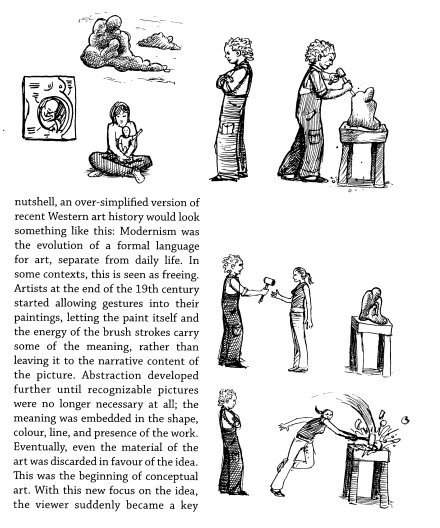
<center><img alt="text by Sally McKay, drawings by Marc Ngui" src="http://nomediakings.org/books/quantal-web.jpg" width="440" height="528" hspace=5 vspace=5 align=center></center><br />
<strong>One of the artists says at one point that another artist's diagrams "baffle" him, but this is the basis for constructive feedback rather than confrontation. You ask one of the artists why he draws so much. There's a fair amount of frank talk here, but it leads somewhere interesting rather than obsession over technical minutia. Did the fact that everyone's comfortable with each other--and many of you are friends--have a lot to do with this?</strong></p>

<p>I knew each of the artists pretty well beforehand, but they didn't really know each other that well. The weird and cool thing about this project is how much they actually do have in common. Everyone has a kind of meta-level interest in investigation, in perception, in the function of sharing knowledge. Everyone works really hard, with an open-ended curiosity, and all of the artists get excited, rather than threatened, by other people's ideas. We held a round table discussion, which I transcribed for the catalogue, and it was one of the most stimulating art conversations I've had the privilege to take part in. This connection, for me, is the best thing about the project. It comes through very strongly in the exhibition and I'm really glad it is there in the catalogue as well.</p>

<p>Note: I couldn't agree with you more about the broken tradition of artists statements. They are painful painful things for most people to write. R.M. Vaughan gave me permission to put his prose poem about artists statements online. Everyone should <a href="http://www.digitalmediatree.com/sallymckay/rmvaughan/">read it</a>, it's hilarious.</p>

<center>~~~</center>

<p><em>A Beginner's Guide to Quantal Strife is available at The Doris McCarthy Gallery UTSC, Art Metropole, The Beguiling, Paul Petro Multiples and YYZ Artists' Outlet or order <a href="http://www.utsc.utoronto.ca/~dmg/html/publications/index.html#QuantalStrife">online</a>. The show Quantal Strife is up at <a href="http://www.utsc.utoronto.ca/~dmg/html/exhibitions/index.html">DMG</a> until March 5th.</em></p>]]>
</content>
</entry>
<entry>
<title>CTHEORY digs on My Trip (Link)</title>
<link rel="alternate" type="text/html" href="http://nomediakings.org/outtasite_links/ctheory_digs_on_my_trip_link.html" />
<modified>2006-02-23T16:05:34Z</modified>
<issued>2006-02-23T16:03:49Z</issued>
<id>tag:nomediakings.org,2006://2.769</id>
<created>2006-02-23T16:03:49Z</created>
<summary type="text/plain">There&apos;s a mention of My Trip to Liberty City as &quot;a great work of popular culture commentary&quot; in the tech journal CTHEORY. (Thanks, Liam!)...</summary>
<author>
<name>Jim Munroe</name>
<url>http://nomediakings.org</url>
<email>jim@nomediakings.org</email>
</author>
<dc:subject>Outtasite Links</dc:subject>
<content type="text/html" mode="escaped" xml:lang="en" xml:base="http://nomediakings.org/">
<![CDATA[<p>There's a mention of My Trip to Liberty City as <a title="CTheory.net" href="http://www.ctheory.net/articles.aspx?id=507">"a great work of popular culture commentary"</a> in the tech journal CTHEORY. (Thanks, <a href="http://liamodonnell.com">Liam</a>!)</p>]]>

</content>
</entry>
<entry>
<title>Risky Business: Indie Book Distribution</title>
<link rel="alternate" type="text/html" href="http://nomediakings.org/doityourself/risky_business_indie_book_distribution.html" />
<modified>2006-02-17T14:52:33Z</modified>
<issued>2006-02-16T16:02:58Z</issued>
<id>tag:nomediakings.org,2006://2.767</id>
<created>2006-02-16T16:02:58Z</created>
<summary type="text/plain">Distribution is one of the toughest nuts to crack when it comes to publishing. There&apos;s a few reasons for this, one of which is that it&apos;s boring. It&apos;s hard to get excited about receivables, warehousing, and invoices. But good distribution has made it possible for me to make a living off my books. When I started thinking about No Media Kings six years ago I thought through doing distribution on my own. I would have to write letters to all the bookstores in Canada, and ship out the orders myself. Assuming that they took it seriously enough to order, and I shipped out the books, they sold, and I followed up with an invoice, I then hit a snag. My invoice would naturally float to the bottom of the pile: those from distributors representing a number of books and publishers would get paid first. They had the leverage of not shipping out any more of their books (and a collection agency), while all I had was the threat of not sending out any more Jim Munroe books. So I discovered the strength-in-numbers value to being with a distributor. Over the years I&apos;ve discovered a few more things about getting your books out into the world. Let&apos;s start with some general concepts of the book distribution business....</summary>
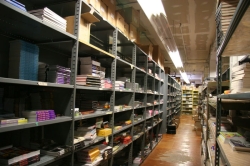
<author>
<name>Jim Munroe</name>
<url>http://nomediakings.org</url>
<email>jim@nomediakings.org</email>
</author>
<dc:subject>Do-It-Yourself</dc:subject>
<content type="text/html" mode="escaped" xml:lang="en" xml:base="http://nomediakings.org/">
<![CDATA[<p><img alt="Warehouses always make me think of the Ark of the Covenant." src="http://nomediakings.org/doityourself/diydistro-thumb.jpg" width="100" height="100" hspace=5 vspace=5 align=left>Distribution is one of the toughest nuts to crack when it comes to publishing. There's a few reasons for this, one of which is that it's boring. It's hard to get excited about receivables, warehousing, and invoices. But good distribution has made it possible for me to make a living off my books. </p>

<p>When I started thinking about No Media Kings six years ago I thought through doing distribution on my own. I would have to write letters to all the bookstores in Canada, and ship out the orders myself. Assuming that they took it seriously enough to order, and I shipped out the books, they sold, and I followed up with an invoice, I then hit a snag. My invoice would naturally float to the bottom of the pile: those from distributors representing a number of books and publishers would get paid first. They had the leverage of not shipping out any more of their books (and a collection agency), while all I had was the threat of not sending out any more Jim Munroe books. So I discovered the strength-in-numbers value to being with a distributor.</p>

<p>Over the years I've discovered a few more things about getting your books out into the world. Let's start with some general concepts of the book distribution business.</p>]]>
<![CDATA[<p><strong>60%-40% SPLIT:</strong> Bookstores get a 40% discount from the distributor, and big box stores often get 45%. This means the bookstore gets $8 when a $20 book sells. </p>

<p><strong>RETURNS:</strong> When a bookstore orders books from a distributor, it is understood that they can ship them back up to a year after they receive them for credit against future orders. Publishers expect, on average, about 30% of their initial sales to be returned. Contrary to popular belief, trade paperbacks are not "stripped" (ie. simply the covers returned for credit to save on shipping, which happens with mass market paperbacks and magazines) so they can be shipped out again when another bookstore orders them.</p>

<p><strong>COMMISSION:</strong> When we discuss sales here we're not talking about sales to the consumer, but within the book trade -- your sales rep will be the person presenting your book to the booksellers either by mailing a catalog or visting in person. The rep works on commission and only gets paid when books "sell through" (ie. are not just ordered by the bookseller, but are sold to the consumer). The distribution company also works on commission, which is one of the reasons they are so picky about taking on non-validated clients: if the books don't sell through, they lose the money they've spent storing and shipping the books. When they do sell through, the sales and distribution combined commission is around 25-30% ($5-6 on a $20 book).</p>

<p>Here are some distro options, staring with the most accessible and going to the least.</p>

<p><strong>Direct Sales</strong></p>

<p>I've sold books directly to people on the street, at zine fairs and at book launches. When I had print runs of 500, it was how I sold most of my books. These days it's not nearly as big a part of how I get my books out there, but I keep doing it because it's fun. I'm pretty sociable and I like to chat with strangers about books, and now that I have a couple of books out it's neat to get feedback from people who've read them. I wasn't so into signing books at the start, it felt bigheaded and silly, but nowadays I offer to do it: most people like a souvenir of a personal interaction. I try to come up with a twist on it to make it more interesting—with my last one I spattered blood on the title page. (OK, it was food colouring, but it was totally evil food colouring.)</p>

<p>I also sell books direct to people via <a href="http://nomediakings.org/buy.htm">this site</a>. I don't mind stuffing envelopes once a week. It doesn't have to be fancy or complicated: PayPal's pretty easy to set up. I was pretty anti-PayPal at first as they had some real problems in Canada a few years ago, but when I did get on that system I found I got more sales. A lot of people have money sitting around in their Pay Pal account and so they're more free with it – I am.</p>

<p>Selling direct means that you can make three times the amount per book than you can make via a sale through traditional bookstore distro. However, even with the amount I do, it only amounts to 10% of my book sales and 1/3 of my income. Bricks-and-mortar bookstores are my bread and butter.</p>

<p><strong>Consignment at Bookstores</strong></p>

<p>Some of the cooler indie bookstores will take books on consignment. A 60% to you, 40% to them split might seem a bit unfair to the uninitiated, but it's the standard in the book trade. Consignment means more paperwork for a product that is less validated by the conventional system of distributors and publishers. I figure if they take that risk, I'm happy to pay the split they're used to. It might help to look like you know what you're doing: get little invoice book to use in case they don't have their own, and books on hand to leave (they'll probably take between 2-5 copies at first). I also follow up after a month, again after three months, and at six months I offer to close the account. Dust on your book doesn't really make anyone look good.</p>

<p>If sales are brisk, some bookstores will offer to buy your book outright which saves on paperwork and hassle. I generally sell it at half the retail price in this case, since the bookstore's assuming a risk. I offer this discount to bookstores when I'm touring in other cities too, since I don't want to deal with consignment through the mail.</p>

<p>Overall, try to work on a relationship with booksellers where you both feel good about the exchange. If you continue to publish books this'll make it much more enjoyable. Remember that people who are selling books generally love them. </p>

<p><strong>Small Distributors</strong></p>

<p><img alt="Last Gasp's warehouse." src="http://nomediakings.org/doityourself/diydistro-web.jpg" width="250" height="166" hspace=5 vspace=5 align=right>There are very few small book distributors, and those that exist tend to be specialist. <a href="http://lastgasp.com/">Last Gasp Distribution</a> (pictured left by Scott Beale of <a href="http://laughingsquid.com">Laughing Squid</a>) focuses on “the unusual, underground, and out-of-the-ordinary” and state in their FAQ that they <a href="http://www.lastgasp.com/faq/#dist">pay you 40%</a> of your cover price if it sells. <a href="http://www.akpress.org/">AK Distribution</a> focuses on political and punk books. Browse a distro's catalog and if they sell stuff like your book, send them a copy and see if they want to stock it. Siue Moffat reports that AK took 200 of her vegan desert cookbook <a href="http://dairyfreedesserts.com">Lickin' the Beaters</a> and sold them all. </p>

<p>An advantage to small distributors is that they generally know their bookstores better than larger distros. The orders tend to be smaller but more realistic. Returns with larger distributors can be very high: 30% returns is expected, but I've seen it go as high as 70%. </p>

<p><strong>Agency</strong></p>

<p>Another option is to make an arrangement with a publisher who already has a distribution deal and a sales team. For a percentage of the sale, they will include your book in their catalog, which goes out with the sales reps to book stores across the country, and their sales team will present your book. Some publishers may want all the attention for their own titles, but some may like the idea: there's no printing cost for them, for instance. Get a cover and the book to them as early as you can, because the catalogs go out 4-6 months in advance.</p>

<p>This is the route I've gone in Canada (thanks <a href="http://www.insomniacpress.com/">Mike</a>!) and have distroed over 5000 books since 2000, an average of about 1200 per title I've published.</p>

<p><strong>Larger Distributors</strong></p>

<p>To you, your press is your passion, your inspiration, your life; to them, it's a financial risk. They don't have the time or inclination to do a case-by-case analysis for every publisher they take on, so they look at how long you've been doing it to make that decision. Most larger distributors won't take you on before you've got four books in print. They will also want you to have a sales team who will present your books to booksellers, to show that you're willing to compete to move those books. Often they will want an exclusive deal for a certain territory (ie. the USA) so that all orders go through them. </p>

<p>They will also prefer you be publishing on an ongoing basis and like a contract for a certain number of years. The reason for this is that they might send you a cheque for books that have sold, but then the books come back and so you end up owing them money. No big deal if you have another new book bringing money in, but a hassle for them if you don't.</p>

<p>Another issue with full service distribution is that the smaller you are – the less money you make for them – the higher their percentage. Again, they want you to assume the risk. Distributors take a minimum of 20%, but it will easily go closer to 30% if you're a small publisher. You'll also be charged a couple of hundred dollars for extras (co-op ads, setup, admin) – between that and the higher percentage, you might find you sell a few hundred books but don't end up making any money. So it's important to find a distribution system that suits your outfit: you don't want more infrastructure than you need. </p>

<p>Don't rent a truck when a wheelbarrow will do. It's not as fancy, but it's cheaper and more appropriate.</p>]]>
</content>
</entry>
<entry>
<title>A Neo-Victorian Subculture</title>
<link rel="alternate" type="text/html" href="http://nomediakings.org/writing/a_neovictorian_subculture.html" />
<modified>2006-02-03T04:55:06Z</modified>
<issued>2006-02-02T15:08:59Z</issued>
<id>tag:nomediakings.org,2006://2.761</id>
<created>2006-02-02T15:08:59Z</created>
<summary type="text/plain">A few years back, a bunch of us were playing Trivial Pursuit. Mark Slutsky (of Automatic Vaudeville fame) was reading out the answers at random, and one of the green science answers was &quot;Slackwater.&quot; Our eyes locked. &quot;What a perfect name...&quot; &quot;...for a youth subculture.&quot; We holed up for a week in Mark&apos;s Montreal apartment and wrote this feature length script imagining what these aristocratic anarchists would be like — destitute but dignified, penniless but proper — and we had a lot of fun doing it. We&apos;ve decided to release it under a Creative Commons licence, which allows anyone to make it into a movie. We&apos;d be happy to see people run with it. For download instructions and a taste of the script&apos;s characters, keep reading!...</summary>
<author>
<name>Jim Munroe</name>
<url>http://nomediakings.org</url>
<email>jim@nomediakings.org</email>
</author>
<dc:subject>Writing</dc:subject>
<content type="text/html" mode="escaped" xml:lang="en" xml:base="http://nomediakings.org/">
<![CDATA[<img alt="The Wyndham pocket-knife." src="http://nomediakings.org/writing/slackwater-thumb.jpg" width="100" height="100" hspace=5 vspace=5 align=left>A few years back, a bunch of us were playing Trivial Pursuit. Mark Slutsky (of <a href="http://autovaud.com">Automatic Vaudeville</a> fame) was reading out the answers at random, and one of the green science answers was "Slackwater."
<p>
Our eyes locked.
<p>
"What a perfect name..."
<p>
"...for a youth subculture."
<p>
We holed up for a week in Mark's Montreal apartment and wrote this feature length script imagining what these aristocratic anarchists would be like — destitute but dignified, penniless but proper — and we had a lot of fun doing it. We've decided to release it under a <a href="http://creativecommons.org/licenses/by-nc-sa/2.5/">Creative Commons licence</a>, which allows anyone to make it into a movie. We'd be happy to see people run with it.
<p>
For download instructions and a taste of the script's characters, keep reading!<br>]]>
<![CDATA[<p><b>Download: <a href="http://nomediakings.org/meettheslackwaters.rtf">rtf</a> | <a href="http://nomediakings.org/meettheslackwaters.doc">doc</a> | <a href="http://nomediakings.org/meettheslackwaters.txt">txt</a> | <a href="http://nomediakings.org/meettheslackwaters.pdb">Plucker pdb</a></b><p>

<em>Meet the Slackwaters: A Subcultural Fable</em> features the following characters...

<h2>Jonah. 
                          The gadabout. The dedicated dilettante.</font></h1>
                        <p>Search 
                          Jonah’s pockets and find these items: <br>
                          A monogrammed handkerchief. <br>
                          The "Wyndham" pocket-knife. <br>
                          A Penguin copy of Baudelaire’s <i>Les Fleurs du Mal.</i> 
                          <br>

                          A ha’penny. <br>
                          A leather pouch containing ten subway tokens. </font> 
                        <h2>Luis. 
                          The flaneur.</font></h1>
                        <p> 
                          In Luis’ many pockets, among other things, are these 
                          items: <br>
                          A ticket to the 1919 World’s Fair. <br>
                          An unopened bottle of “Moxie” soda pop. <br>

                          A ragged page of lyric verse. <br>
                          A cheese sandwich, sliced lengthwise, in a ziplock bag. 
                          <br>
                          A spying-glass. </font> 
                        <p> 
                        <h2>Anna. 
                          The seeker of curiosities.</font></h1>
                        <p> <img src="http://nomediakings.org/images/thimble.JPG" border=0 align=left vspace=5 hspace=5>Anna 
                          carries the following things with her: <br>
                          A book of the lives of the saints. <br>

                          A silver thimble. <br>
                          A crumpled print depicting St. Francis of Assisi among 
                          the birds. <br>
                          A small bottle of smelling-salts.
                        <BR CLEAR=LEFT><h2>Stefan. 
                          The student. The artist.</h1>
                        <p>
                          Stefan’s shoulder-bag and pockets contain these items: 
                          <br>
                          A university student card. <br>

                          Ten paintbrushes, bound by an elastic band. <br>
                          A can of silver spray-paint. <br>
                          Graham Greene’s <i>The End of the Affair</i>. <br>
                          A walkman. 
                        <h2>Amelia. 
                          The alchemist. The apothecarist.</font></h1>
                        <img src="http://nomediakings.org/images/mag.JPG" border=0 align=left vspace=5 hspace=5>Amelia 
                        carries with her: <br>

                        Ten little bottles of brightly-colored fluids. <br>
                        A receipt from Zellers. <br>
                        A bundle of strange-looking twigs. <br>
                        A tortoiseshell pocket-magnifier. </font> 
                        <BR CLEAR=LEFT><p align=center>#</p>
                        The images for 
                        this page were furnished by Harrod's Stores 1895 Catalogue. Text written by Mark Slutsky.
<p>
Those of you fond of MP3s & movies should also check out Mark's new project, <a href="http://www.autovaud.com/2006/01/automatic-podville.html">Automatic Podville</a> (<a href="http://phobos.apple.com/WebObjects/MZStore.woa/wa/viewPodcast?id=118451477&s=143455">iTunes link</a>). <br>]]>
</content>
</entry>
<entry>
<title>Worth Wiretapping (Link)</title>
<link rel="alternate" type="text/html" href="http://nomediakings.org/outtasite_links/worth_wiretapping_link.html" />
<modified>2006-01-25T20:48:18Z</modified>
<issued>2006-01-25T20:44:05Z</issued>
<id>tag:nomediakings.org,2006://2.759</id>
<created>2006-01-25T20:44:05Z</created>
<summary type="text/plain">The second segment on this amazing Wiretap podcast appears to be a funny pig story, but then transforms like manimal before your very eyes. (Thanks, Craig!)...</summary>
<author>
<name>Jim Munroe</name>
<url>http://nomediakings.org</url>
<email>jim@nomediakings.org</email>
</author>
<dc:subject>Outtasite Links</dc:subject>
<content type="text/html" mode="escaped" xml:lang="en" xml:base="http://nomediakings.org/">
<![CDATA[<p>The second segment on this <a title="the future is yesterday » Wiretap - Of Man and Beast" href="http://redjar.org/jared/blog/archives/2005/12/30/wiretap-of-man-and-beast/">amazing Wiretap podcast</a> appears to be a funny pig story, but then transforms like manimal before your very eyes. (Thanks, <a href="http://superbrothers.ca/">Craig</a>!)</p>]]>

</content>
</entry>
<entry>
<title>Video Compression Howto (Link)</title>
<link rel="alternate" type="text/html" href="http://nomediakings.org/outtasite_links/video_compression_howto_link.html" />
<modified>2006-01-22T19:50:37Z</modified>
<issued>2006-01-22T19:43:56Z</issued>
<id>tag:nomediakings.org,2006://2.758</id>
<created>2006-01-22T19:43:56Z</created>
<summary type="text/plain">The folks over at Rocketboom talk about the various video compression methods they use to make their daily internet show. (Thanks, Kirby!)...</summary>
<author>
<name>Jim Munroe</name>
<url>http://nomediakings.org</url>
<email>jim@nomediakings.org</email>
</author>
<dc:subject>Outtasite Links</dc:subject>
<content type="text/html" mode="escaped" xml:lang="en" xml:base="http://nomediakings.org/">
<![CDATA[<p>The folks over at Rocketboom talk about the various <a href="http://www.rocketboom.com/extra/video_tools/">video compression methods</a> they use to make their daily internet show. (Thanks, <a href="http://www.goodiebag.tv/blog.htm">Kirby</a>!)</p>]]>

</content>
</entry>
<entry>
<title>Selling Ads for Small Mags (Link)</title>
<link rel="alternate" type="text/html" href="http://nomediakings.org/outtasite_links/selling_ads_for_small_mags_link.html" />
<modified>2006-01-22T19:50:57Z</modified>
<issued>2006-01-22T19:29:15Z</issued>
<id>tag:nomediakings.org,2006://2.757</id>
<created>2006-01-22T19:29:15Z</created>
<summary type="text/plain">Gabino Travassos, publisher of the excellent music mag Mote, has a practical howto on getting ads for small magazines....</summary>
<author>
<name>Jim Munroe</name>
<url>http://nomediakings.org</url>
<email>jim@nomediakings.org</email>
</author>
<dc:subject>Outtasite Links</dc:subject>
<content type="text/html" mode="escaped" xml:lang="en" xml:base="http://nomediakings.org/">
<![CDATA[<p>Gabino Travassos, publisher of the excellent music mag Mote, has a practical howto on <a href="http://www.motemagazine.com/blog/index.php?id=gabino020209">getting ads for small magazines</a>.</p>]]>

</content>
</entry>
<entry>
<title>Do-It-Yourself Book Promotion</title>
<link rel="alternate" type="text/html" href="http://nomediakings.org/doityourself/doityourself_book_promotion.html" />
<modified>2006-01-19T16:58:08Z</modified>
<issued>2006-01-19T15:03:57Z</issued>
<id>tag:nomediakings.org,2006://2.755</id>
<created>2006-01-19T15:03:57Z</created>
<summary type="text/plain">I&apos;ve come to realize that I don&apos;t hate advertising so much as have an allergic reaction to a high-hype-to-low-content ratio: like when the inner ear is imbalanced, when marketing TALKS LOUD and SAYS NOTHING NEW it induces what I call hype nausea. So promoting my books was initially a challenge for me. But since I wrote my first DIY Book Promo article five years ago, I&apos;ve brought public attention to three more novels and now quite enjoy it. Here&apos;s some of the things I think about when I craft a promotional campaign....</summary>
<author>
<name>Jim Munroe</name>
<url>http://nomediakings.org</url>
<email>jim@nomediakings.org</email>
</author>
<dc:subject>Do-It-Yourself</dc:subject>
<content type="text/html" mode="escaped" xml:lang="en" xml:base="http://nomediakings.org/">
<![CDATA[<p><img alt="Alien helmet for the AYS tour by Sandy Plotnikoff." src="http://nomediakings.org/doityourself/diypromo-thumb.jpg" width="100" height="100" hspace=5 vspace=5 align=left>I've come to realize that I don't hate advertising so much as have an allergic reaction to a high-hype-to-low-content ratio: like when the inner ear is imbalanced, when marketing TALKS LOUD and SAYS NOTHING NEW it induces what I call <em>hype nausea</em>. So promoting my books was initially a challenge for me. But since I wrote my first DIY Book Promo article five years ago, I've brought public attention to three more novels and now quite enjoy it. Here's some of the things I think about when I craft a promotional campaign.</p>]]>
<![CDATA[<p><strong>GENERAL PHILOSOPHY</strong></p>

<p>A few years ago I can clearly remember watching a video documentation of performance art – and unlike most performance art, I really liked it. I was also a bit bamboozled by how the artist would have come up with the idea to do it. As a person who regularly had ideas for stories pop into his head, I knew it wasn't simply a lack of creativity on my part: it was more an unfamiliarity with the medium that made it seem so difficult to imagine doing myself.</p>

<p>However, it opened up a curiosity about working in that medium, and once I started thinking along those lines my creativity kind of grew in that direction. I've talked with people who originally never could have imagined making a short movie, but once they made one they were “hooked” and constantly had ideas of new vids to make. Most artists have one medium that their creativity flows through, like a main river: working in different mediums is like digging tributaries to irrigate different parts of the brain.</p>

<p>I've come to treat promotion as a medium in its own right. When I realized I could use the same creative muscle I use to write my books in promoting them, and that I could control the hype-to-content ratio as I saw fit, promotion became an interesting creative challenge. </p>

<p><strong>TITLE</strong></p>

<p>Years later, people are still coming across <a href="http://nomediakings.org/buy.htm#flyboy">Flyboy Action Figure Comes With Gasmask</a> in libraries and bookstores and picking it up for the title alone. You don't want to use a catchy title simply for catchiness' sake, but if you can get one that's both interesting and reflective of its content then you're set.</p>

<p><strong>DESIGN</strong></p>

<p>This seems self-evident, but the cover of a book is its face to the world, and a key promotional tool. Go to a bookstore with a mockup and put it on the new arrivals stack, see how it looks. Would you pick it up? It may be beautifully and cunningly detailed, but keep in mind it has to work both close up and far away. Pay attention to the spine too, since that's going to see a lot of face time and is often just an afterthought.</p>

<p>On another level, you want the cover to be both reflective of the content and compelling in some way. It can be both, and should be. If you go with a fluorescent colours with a half-naked girl on the cover, you might get a high percentage of males picking it up: but unless that's reflective of the content, they'll put it down just as quickly. An appropriate, engaging cover will get a high percentage of the kinds of people who would like the book to pick it up.</p>

<p>I've been torn about the use of blurbs in the past, and have used them sometimes and not others. Essentially author blurbs and media blurbs are votes of confidence and credibility, and complement the back cover copy rather than repeat it. However, I do think it helps if, again, it's appropriate: don't ask Clive Barker for a blurb if your work wouldn't appeal to fans of Clive Barker. If there's some shared sensibility between your work and an author you like, you can ask if it'd be alright to send a copy of your book out to them. In the letter, let them know why you are asking them; no one likes to feel used.</p>

<p><strong>PITCH</strong></p>

<p>This is a challenge: how to summarize 100,000 words into about ten. But again, think of it as an adaptation that reflects the gist of the content. One of the easiest books to promote was <a href="http://nomediakings.org/buy.htm#AYS">Angry Young Spaceman</a>, which was “about a guy who goes to another planet to teach English.” It gets across the gist of the book but also gives a flavour of the kind of humour in it. (I also think that the lighter and shinier the description is, the more easily it will flit around via word of mouth.) I sit down and brainstorm ways to describe my work in progress early on since people inevitably ask me about it at parties and whatnot, and it's more fun to try out a one-liner than a mumbled and dull summary. </p>

<p><a href="http://nomediakings.org/buy.htm#silico">Everyone In Silico</a> defied my best attempts at summary, so I sent letters to the companies I'd mentioned in the book and invoiced them for product placement. The <a href="http://nomediakings.org/invoice.htm">Past Due letters project</a> stemmed from a feeling that I wanted to take these companies to task more directly than I could in the novel, which was more about the absence of corporate critique. This made for a good performance (see below) and also allowed me to make political points with a promotional campaign – adding substantial content to the hype. It felt like I was able to hook up a payload of agit-prop to a capitalist engine.This combination not only made me more engaged, but was a great reason for media to cover me and my book in a story about product placement. (Conflict, or even perceived conflict, is a great attractor for media.) It wasn't the kind of campaign that a marketing department would have been likely to come up with: the idea came about from my immersion in the material as the creator.</p>

<p><strong>PERFORMANCE</strong></p>

<p><img alt="photo by Janet Bailey" src="http://nomediakings.org/images/launch8.jpg" hspace=5 vspace=5 align=right>There's really no need to add another dull reading to the pile. Especially when you're starting out, people aren't fixated on hearing a certain passage from your books: in fact, they probably don't care if you read at all. Show a slide show of photos from the country that inspired the setting of the book, or do covers of the songs that your main character sings. People come to get a sense of your personality, and what you're like in person. The majority of readings are boring, for lots of reasons, one of which is simply technical: it's confusing for the listeners to shift between dialogue and exposition, it's easy to get lost and zone out. </p>
<p>Look at your performance as an adaptation of the material in the book for a theatrical setting. For Angry Young Spaceman, I did s <a href="http://nomediakings.org/TEOOP.htm">fake slideshow/info session</a> on how you! can teach English on other planets, and included interactive alien artifacts liike the one pictured at right; for Everyone In Silico I read the Past Due letters; and for An Opening Act of Unspeakable Evil I did <a href="http://nomediakings.org/events/libraries_rule_part_2.html">rituals of the urban occult</a>. Even with my limited talent in performance, I was able to get more attention for my books (and have more fun doing it) than if I'd just read from the book. There are exceptions to the rule – the talented Joe Meno does straight readings from his book and because his material works so well being read aloud, he has people bumrushing the merch table like he'd just played a rock show. </p>

<p>Anyone who's interested in touring should consider signing up for the <a href="http://perpetualmotionroadshow.com">Perpetual Motion Roadshow</a>, an indie press touring circuit I founded. Touring is an amazing thing.</p>

<p><strong>OUTREACH TO BOOKSELLERS AND READERS</strong></p>

<p>One of the things to keep in mind is that you want your promotional campaign to take into account three audiences: potential readers, booksellers and media. People will often forget about how pivotal the role of booksellers can be: if they don't order your book and have it on the shelves, a key element in getting your book into the world is missed. I have one bookseller who has hand sold hundreds of my books. Big media hits won't translate into sales if booksellers haven't ordered any books, so you'll want to coordinate distribution beforehand. Sometimes distributors will have programs set up (such as Booksense in the US) that send promo postcards and advance copies to booksellers. You can offer to sign books at your local bookstores and feel out if they'd be interested in hosting an event. </p>

<p>The standard promo that publishers put out for its versatility and cheapness is the postcard, usually with the ISBN and pub date on the back. These have their place but I expect the majority of them get trashed pretty quick. Personally I think that stickers and buttons are more interesting giveaways, and bonus points if there's a connection to the book. Think about what you'd like to get. And it's a good idea to make promo items that live on the web (I had a <a href="http://nomediakings.org/AYS.mov">screensaver</a> made for Angry Young Spaceman), but don't neglect the real world. They reinforce each other. For instance, someone half pays attention to your launch details email, and when they half notice the street poster for it, they talk to the person they're walking with about maybe going to it.</p>

<p>One of the best promo pieces I had began as a huge mistake. A page number was misprinted in an obvious way in the proof for Everyone In Silico, but the signatures (the little 20-30 page booklets that, bound together and glued, make the book) had already been printed. I had to reprint the first signature (which would cost $250 extra) and was about to get them to trash the first signature when I realized that it ended on a chapter break. So I printed up a cover for it and distributed the signatures as free samples of the beginning of the book, and had 2500 copies to give away for the very reasonable price of $250. I dropped stacks off at bookstores and heard that it was effective from the booksellers as well as getting more people out to the launches. Letting them know you want to be an active part of selling your book, and giving them tools to do it, helps out a lot.</p>

<p>In terms of outreach to readers, one of the hugest assets that I've had is direct contact with my readers through an email list. The earlier you start something like this the better. I think a key to a relationship with readers is to provide interesting stuff beyond sales pitches: to have a decent hype-to-content ratio. I post full articles I've written, try to share some ideas and strategies through articles like these, and talk about like-minded projects. I've offered <a href="http://nomediakings.org/misc/a_one_inch_peephole_into_my_brain.html">free buttons</a> in exchange for distributing promo in their town.</p>

<p>I also give away e-books and while it has <a href="http://nomediakings.org/writing/free_ebook_released.html">no perceivable effect</a> on my book sales, it certainly spreads the word to people too broke to buy books. Often people will talk about it with their friends, and other times they'll buy the next one once they feel it's a sure bet. My most recent book was written in the form of blog entries, so I made <a href="http://roommatefromhell.com/">a faux blog</a> and posted one entry a day until the whole book was online.</p>

<p>I send free books to people whose work I really like, both who I know and don't know. It's hard to do this when you've just paid a printer bill, but here's what happens when I get a free book I really like: I'll pass it off to someone I know reviewing books in the media, or at the very least I talk about it a bunch.</p>

<p><strong>MEDIA</strong></p>

<p>Sean Lerner's done an excellent job writing about <a href="http://nomediakings.org/doityourself/efficient_media_outreach.html">media outreach</a>, but here are a couple of things I've learned in respect to my books. With one novel, I did 150 mailouts to everyone who's ever reviewed a book in Canada; with another novel I targeted specific media contacts to save on costs. I think I favour the shotgun rather than the scalpel approach. One reason is turnover: the same mag who didn't review one book might have a new person in charge now. Another reason is familiarity breeds contempt: a reporter who thrives on novelty won't be interested in covering you twice (or thrice) while a reporter at a different paper that hasn't heard of you might be in the mood to heap praise. Big mailouts are expensive, but I look at it as covering my bases.</p>

<p>My media packs consist of a promo piece, a copy of the book and a <a href="http://nomediakings.org/tipsheet.pdf">one page media sheet</a> which has a bunch of hooks or interesting angles for media to write something beyond a review. Media or author blurbs can help build credibility and give confidence to reporters trying to get a story idea approved. Providing an image or <a href="http://nomediakings.org/pictures.htm">a link</a> to a high-res online image of the author or the book or something more creative makes it even more appealing as reporters' deadlines loom. Another excellent tool is listing a launch party date, or a tour, that can lend a timely hook to covering it as an event. Reporters have ten potential story ideas at one time, and having a date connected to your book gives a rationale for writing about it sooner rather than later. Naturally getting the media pack to them three weeks or a month before the date in question is essential, and you might want to get someone to call and follow up to make sure that the package was received and, if they sound interested, offer to schedule an interview. The follow-up call is the one thing I think is better to have someone else do: a bit of a buffer makes things easier for all parties. You don't want to guilt a reporter into doing a story, you want them to be as excited as you are.</p>

<p>Again, like the bookstores, you're trying to make it easy for them to spread the word about your book. They're your allies in this – their job is writing interesting and exciting stories, so try and make it easy that the story be about you and your book. And when they don't – because the majority of the time they won't – try not to be bitter about it. It's a long life, you've got more than one book in you and if you can keep on making stuff and letting people know eventually people take notice.</p>

<center>~~~</center>

<p><i>My original 2000 DIY Book Promo article is archived <a href="http://nomediakings.org/Promotion.htm">here</a>.</I></p>]]>
</content>
</entry>
<entry>
<title>Her Charmed Life</title>
<link rel="alternate" type="text/html" href="http://nomediakings.org/books/her_charmed_life.html" />
<modified>2006-01-13T19:58:30Z</modified>
<issued>2006-01-11T19:47:43Z</issued>
<id>tag:nomediakings.org,2006://2.749</id>
<created>2006-01-11T19:47:43Z</created>
<summary type="text/plain">I met Missy Kulik at an indie media conference where I was doing a DIY Books seminar. I picked up a couple of her comics and we&apos;ve kept in touch ever since. Her first book, Personal Charm, was self-published in June: or as the copyright page more originally puts it, &quot;First Pressing June 2005.&quot; We chatted by email about her book, which has its roots in ten years of zine making....</summary>
<author>
<name>Jim Munroe</name>
<url>http://nomediakings.org</url>
<email>jim@nomediakings.org</email>
</author>
<dc:subject>Books</dc:subject>
<content type="text/html" mode="escaped" xml:lang="en" xml:base="http://nomediakings.org/">
<![CDATA[<p><img alt="missy-thumb.jpg" src="http://nomediakings.org/books/missy-thumb.jpg" width="100" height="100" hspace=5 vspace=5 align=left>I met Missy Kulik at an indie media conference where I was doing a DIY Books seminar. I picked up a couple of her comics and we've kept in touch ever since. Her first book, <em>Personal Charm</em>, was self-published in June: or as the copyright page more originally puts it, "First Pressing June 2005." We chatted by email about her book, which has its roots in ten years of zine making. </p>]]>
<![CDATA[<p><strong>I like how you mention not only when something happened, but how much time has passed before you drew it. Can you talk about the process there? Do you make notes?</strong></p>

<p>I was doing a daily comic every day for over two years, and drawing weekly with my friend Todd Bak. I would sit at work or home and write what I did each day to try and make a comic out of something, even if it was just about the weather or my cat. Then, when Todd and I got together, I would do a whole week's worth of journals in a night, so there is the date it happened and the date I drew the comic. That was always more for my records than the reader, so I was not sure if people paid attention to the dates like I do. Needless to say, I got a little burnt out on the whole thing, so I stopped, but I plan to begin again January first. Hopefully.<br />
<img alt="missy-web.jpg" src="http://nomediakings.org/books/missy-web.jpg" width="500" height="441" hspace=5 vspace=5 align=left></p>

<p><strong>Can you talk about the title? How do you feel about charm in other people, yourself?</strong></p>

<p>I didn't want to call the book <em>Pocket</em>, like my zine, and we were watching Irene Moon's performance and a slide came on and it had retro clip-art and said "Personal Charm." I thought that would make a good title for my book, or any book I would make in the future. I guess I see it as almost a "charmed life" sort of thing, cos I do not know what I would be doing if it weren't for the people I met through my zines and comics.</p>

<p>As for charm in other people, I feel some people are, some aren't. You just have to look hard sometimes! </p>

<p><strong>You write about a lot of stuff, car accidents to sock monkeys. Are there things that you don't make comics about? Why not?</strong></p>

<p>Yeah, I do censor myself. There are some of the journal comics I do for myself that I would not show the person that they are about. I don't want people to feel like I am out to get them in my work! I like to disguise things, I guess, like silly stuff, like liking boys or dreams, whatever. Slumber party stuff, like that.</p>

<p><strong>What was the worst and the best thing about making this book yourself?</strong></p>

<p>The best is getting reviewed in funny places like <em>Giant Robot</em> and seeing what others say about it, and gaining a new audience. The hardest part is distribution while holding a full time job.</p>

<p><I>You can order a copy of Personal Charm via <a href="http://www.indiepages.com/missy/readables.html">Missy's site</a> or <a href="http://www.topshelfcomix.com/">Top Shelf Comics</a>. If you liked this interview you might also dig on these <a href="http://nomediakings.org/threat.htm">interviews of self-publishers</a>.</i></p>]]>
</content>
</entry>

</feed>